An Active Harmonic Filter (AHF) is usually better for variable nonlinear loads, mixed VFD systems, UPS loads, EV chargers and plants where harmonic conditions change during operation. A passive harmonic filter can be suitable when the harmonic spectrum is stable, the target harmonic orders are known, and the electrical system has been checked for resonance risk. The right choice depends on measured THDi, individual harmonic orders, load profile, capacitor banks, system impedance, installation space and the required harmonic target.
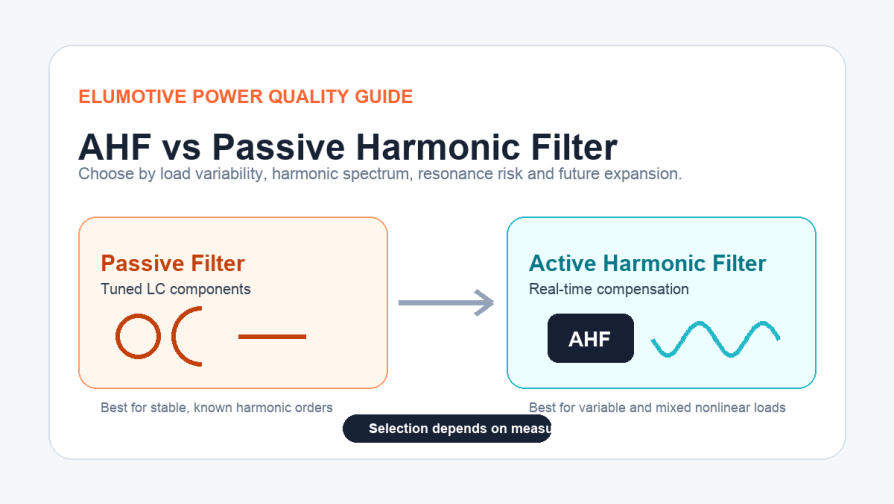
Image placement: use a split technical graphic after the introduction. Recommended visual: passive LC filter on the left, Active Harmonic Filter with real-time compensation waveform on the right.
Industrial plants use more power electronics than ever before. Variable frequency drives, UPS systems, rectifiers, welding machines, EV chargers and inverter-based equipment can all create harmonic current. When harmonic current flows through transformers, cables and system impedance, it may increase losses, cause overheating, disturb capacitor banks and create voltage distortion.
Shanghai Elumotive Technology provides Active Harmonic Filter, Active Power Filter, Static Var Generator, SVG, STATCOM and complete power quality solutions for industrial applications. This article compares AHF and passive harmonic filters from an engineering selection point of view.
A passive harmonic filter uses passive electrical components such as capacitors, reactors and sometimes resistors. It is usually tuned to a specific harmonic frequency or a narrow harmonic range. For example, a passive filter may be designed to reduce the 5th harmonic or the 7th harmonic produced by a known group of drives.
Passive filters can be effective in stable systems, especially when:
However, passive filters are not universal. Their performance depends on system conditions. If the load changes, if new VFDs are added, or if capacitor banks interact with system impedance, the filter may not work as expected.
An Active Harmonic Filter, also called AHF or Active Power Filter (APF), uses power electronics and real-time control to reduce harmonic current. Current transformers measure the load current or source current. The AHF controller detects harmonic components and injects an opposite compensation current into the system.
Unlike a passive filter, an AHF is not tuned to only one fixed frequency. It can compensate multiple harmonic orders dynamically, such as the 5th, 7th, 11th and 13th harmonics. This makes it useful for systems where load conditions change throughout the day.
For a basic explanation, read: What Is an Active Harmonic Filter and How Does It Work?
| Comparison Item | Active Harmonic Filter | Passive Harmonic Filter |
| Working principle | Measures harmonics and injects opposite compensation current | Uses tuned capacitors and reactors to absorb selected harmonics |
| Best fit | Variable nonlinear loads and mixed equipment | Stable loads with predictable harmonic orders |
| Harmonic range | Can compensate multiple harmonic orders dynamically | Usually tuned to specific orders |
| Load change response | Adapts in real time | Performance may change when load or system impedance changes |
| Resonance risk | Lower tuning-related resonance risk, but system review is still needed | Must be carefully checked for resonance with capacitor banks and system impedance |
| Expansion flexibility | Modular options can support future load growth | May need redesign if load changes significantly |
| Typical applications | VFD groups, UPS systems, EV chargers, data centers, mixed industrial plants | Stable drive systems or engineered harmonic filter banks |
| Key selection data | Load current, THDi, harmonic spectrum, CT location, target THDi | Harmonic spectrum, system impedance, capacitor/reactor design, tuning point |
An Active Harmonic Filter is often the better choice when the harmonic source is dynamic or mixed.
Typical examples include:
AHF is also useful when engineers need a flexible solution that can adapt after installation. For example, if the plant later adds more VFDs, a modular AHF cabinet may allow additional capacity.
For sizing guidance, read: Active Harmonic Filter Sizing Guide for VFD Loads
A passive harmonic filter can be suitable when the site is stable and the harmonic problem is well defined.
It may be considered when:
Passive filters are not simply “old technology.” They can still be effective when correctly designed. The key is that passive filters need careful engineering. Poorly selected passive filters can cause unexpected resonance or fail to reduce harmonics under real operating conditions.
| Application Scenario | Better Starting Option | Why |
| Mixed VFD production line | Active Harmonic Filter | Load and harmonic current change during operation |
| Stable single drive system | Passive filter or AHF | Passive may work if harmonic order and system impedance are stable |
| UPS or rectifier loads | Active Harmonic Filter | Harmonic profile can vary with load demand |
| EV charging station | Active Harmonic Filter | Charger utilization changes throughout the day |
| Existing capacitor bank failures | Engineering review before selection | Resonance and detuned reactor design must be checked |
| Plant with both harmonics and low power factor | AHF + SVG review | AHF targets harmonics; SVG targets dynamic reactive power |
| Future production expansion | Active Harmonic Filter | Modular expansion is usually easier |
The lowest initial equipment cost is not always the lowest project cost. Harmonic mitigation equipment should be evaluated by performance, installation conditions, expansion needs and maintenance risk.
Passive filters may have lower initial cost for simple and stable applications. However, they require correct tuning and system review. If the plant changes loads, the filter may need redesign or additional engineering.
Active Harmonic Filters usually have higher electronics complexity, but they provide real-time compensation and broader flexibility. For mixed VFD systems, EV charging, data centers and facilities with future expansion, that flexibility can be valuable.
Capacitor banks are often used for power factor correction. In harmonic systems, capacitors can interact with system inductance and create resonance. This may amplify harmonic current or voltage at certain frequencies.
This is especially important when selecting passive filters. A passive filter contains capacitors and reactors, so its tuning must be reviewed together with the rest of the electrical system.
Before choosing a harmonic mitigation solution, check:
For THDi and THDv definitions, read: THDi vs THDv: What Is the Difference in Power Quality?
It is important not to confuse harmonic mitigation with reactive power compensation.
An Active Harmonic Filter is mainly selected to reduce harmonic current and lower THDi. A passive harmonic filter is also selected for harmonic mitigation, but it uses tuned passive components. A Static Var Generator (SVG) is mainly selected for dynamic reactive power compensation and power factor correction.
Some sites need more than one solution:
| Site Problem | Main Solution to Review | Note |
| High THDi from VFDs | AHF or passive harmonic filter | Selection depends on load variability and harmonic spectrum |
| Low power factor | SVG or capacitor bank | SVG is better for fast-changing reactive power |
| High THDi and low power factor | AHF + SVG | Combined solution may be needed |
| Capacitor bank overheating | Power quality audit first | Check harmonic resonance before adding equipment |
| Voltage distortion | Harmonic mitigation plus system review | THDv depends on harmonic current and system impedance |
For AHF and SVG comparison, read: Active Harmonic Filter vs Static Var Generator: What Is the Difference?
Before choosing between AHF and passive harmonic filters, collect measurement data. Supplier selection should not rely only on motor power or transformer capacity.
Useful data includes:
Use this simple logic for early discussion:
This early logic does not replace engineering calculation, but it helps avoid mismatched equipment.
No. AHF is usually better for variable or mixed nonlinear loads, but passive filters can work well in stable systems with known harmonic orders. The best option depends on measured data and system conditions.
Yes. Passive filters use capacitors and reactors, so they must be reviewed with system impedance and existing capacitor banks. Poor tuning can increase resonance risk.
For multiple VFDs or changing production loads, an Active Harmonic Filter is often the better starting option. For one stable drive system, a passive filter may be considered after harmonic and resonance analysis.
An AHF can improve true power factor by reducing harmonic distortion, but it is not the same as an SVG. If the main problem is displacement power factor or fast-changing reactive power, a Static Var Generator may be needed.
The most important data includes load current, THDi, THDv, individual harmonic spectrum, transformer information, capacitor bank details and the target compensation point.
Yes. Elumotive can review measurement data, application conditions, capacitor bank information and target harmonic limits to recommend whether the project should use AHF, passive filtering, SVG or a combined power quality solution.
AHF and passive harmonic filters both reduce harmonics, but they fit different project conditions. A passive harmonic filter can be suitable for stable loads with known harmonic orders and carefully reviewed resonance conditions. An Active Harmonic Filter is usually better for variable nonlinear loads, mixed VFD systems, UPS loads, EV chargers and plants that need flexible real-time harmonic compensation.
The best selection starts with measurement data. Engineers should review THDi, THDv, harmonic spectrum, load profile, capacitor banks, system impedance and future expansion before choosing equipment.
If your project has harmonic current problems, send Elumotive your power quality report and application details for an initial solution review.
CTA: Contact Elumotive for an AHF vs passive harmonic filter selection review. Send voltage level, transformer capacity, load current, THDi/THDv report, harmonic spectrum, capacitor bank details and installation photos.
Contact: sales@elumotive.com
Website: https://www.elumotive.com