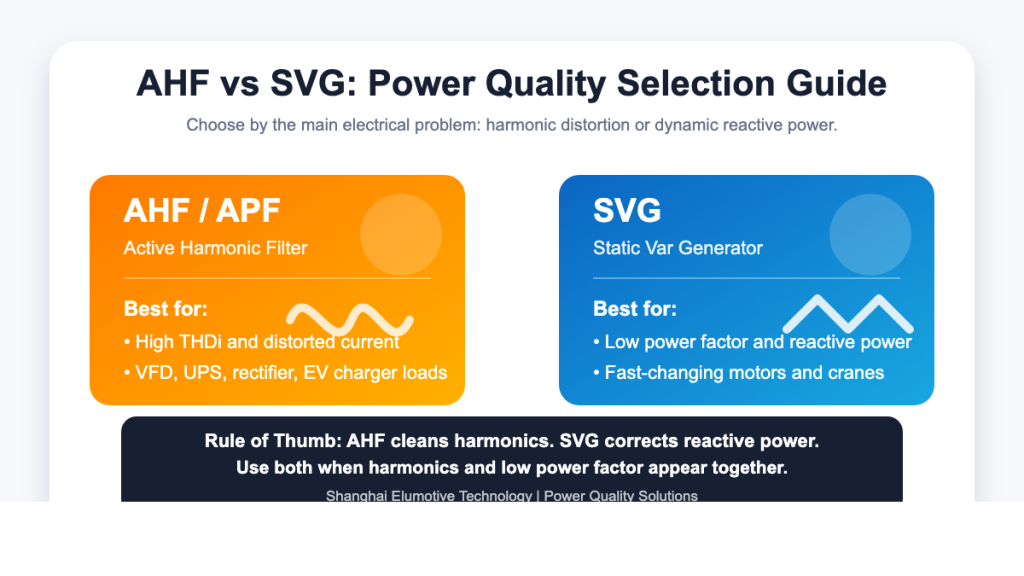
When a factory, commercial building, data center or renewable energy project starts facing power quality problems, two solutions are often discussed first: Active Harmonic Filter (AHF/APF) and Static Var Generator (SVG).
Both are power electronics devices. Both are installed in low-voltage or medium-voltage distribution systems. Both can improve electrical performance. But they are not the same product, and choosing the wrong one may leave the main problem unsolved.
In simple terms:
This guide explains the difference, typical selection logic, and the key data points engineers should review before choosing a solution.
| Item | Active Harmonic Filter (AHF/APF) | Static Var Generator (SVG) |
|---|---|---|
| Main purpose | Harmonic current compensation | Reactive power compensation |
| Main problem solved | High THDi, distorted current waveform, overheating caused by harmonics | Low power factor, rapid reactive power fluctuation, voltage instability |
| Typical target | Reduce harmonic current distortion, often toward IEEE 519 project limits | Improve power factor, often close to 0.99 under changing load |
| Compensation method | Injects reverse harmonic current to cancel load harmonics | Injects or absorbs reactive current dynamically |
| Response speed | Fast electronic response, usually in milliseconds | Fast electronic response, usually in milliseconds |
| Common loads | VFDs, UPS, rectifiers, EV chargers, welding machines, nonlinear loads | Motors, cranes, elevators, compressors, rolling mills, solar plants, substations |
| Main benefit | Cleaner waveform, lower harmonic stress, better transformer and cable reliability | Better power factor, lower reactive penalties, improved voltage support |
| Best for | Harmonic mitigation | Dynamic power factor correction |
| Often combined with | SVG, capacitor banks, reactors | AHF, capacitor banks, power quality controllers |
An Active Harmonic Filter is a power quality device designed to reduce harmonic currents generated by nonlinear loads.
Modern electrical systems use many nonlinear devices: variable frequency drives, rectifiers, UPS systems, LED drivers, welding equipment, EV chargers and other power electronics. These loads draw current in pulses instead of smooth sine waves. As a result, they create harmonic currents such as the 3rd, 5th, 7th, 11th and 13th harmonics.
An AHF measures the harmonic current in real time and injects an opposite current waveform into the system. The result is a cleaner current waveform at the point of common coupling.
Typical benefits include:
A Static Var Generator is a dynamic reactive power compensation device. It helps improve power factor and stabilize voltage by injecting or absorbing reactive current.
Traditional capacitor banks are useful for fixed or slowly changing reactive power loads, but many modern industrial loads change quickly. A crane, elevator, welding machine or rolling mill can create rapid reactive power fluctuation. In these cases, traditional capacitor switching may be too slow or too coarse.
An SVG uses power electronics to provide fast and continuous reactive power compensation. It can respond to load changes in milliseconds and maintain a more stable power factor.
Typical benefits include:
The easiest way to understand the difference is this:
AHF cleans distorted current. SVG corrects reactive power.
If your system has high harmonic distortion, an SVG alone will not fully solve it. If your system mainly has low power factor caused by reactive power, an AHF alone may not be the most cost-effective solution.
| Symptom in the electrical system | Likely cause | Recommended solution |
|---|---|---|
| High THDi measured at main panel | Nonlinear loads such as VFDs, UPS or rectifiers | AHF |
| Transformer runs hot under normal load | Harmonic currents and current distortion | AHF, plus system study |
| Utility charges reactive power penalty | Low power factor | SVG or capacitor bank |
| Power factor changes quickly during operation | Dynamic reactive load | SVG |
| Capacitor banks fail frequently | Harmonic resonance or switching stress | AHF + reactor review, or SVG |
| Voltage fluctuates when heavy machines start | Dynamic reactive power demand | SVG |
| Both THDi is high and power factor is low | Nonlinear loads with reactive demand | AHF + SVG combined solution |
Before selecting AHF or SVG, engineers should collect real operating data. A short-term power quality measurement is usually better than guessing from nameplate values.
Key parameters include:
Many projects use IEEE 519 as a reference for harmonic control at the point of common coupling. For voltage distortion, 5% total harmonic distortion is commonly used as a reference limit in many low-voltage and medium-voltage systems, but the final target depends on voltage level and project conditions.
The following simplified examples show how engineers often translate measurement data into an initial AHF or SVG selection. Final sizing should always be confirmed with a power quality report and site conditions.
Assume an industrial load operates at 500 kW and the measured power factor is 0.82. The target power factor is 0.99.
| Item | Before compensation | After SVG compensation target | Improvement |
|---|---|---|---|
| Active power | 500 kW | 500 kW | Same production output |
| Power factor | 0.82 | 0.99 | Higher utility-side power factor |
| Apparent power | About 610 kVA | About 505 kVA | About 105 kVA released capacity |
| Reactive power | About 349 kvar | About 71 kvar | About 278 kvar compensation need |
In this case, the core problem is reactive power. An SVG sized around the measured dynamic kvar demand can help the plant reduce apparent power, improve power factor and release transformer capacity.
Assume a feeder carries 800 A and the measured current distortion THDi is 30%. A simplified estimate of harmonic current is:
| Item | Value | Engineering meaning |
|---|---|---|
| Load current | 800 A | Current at the measured feeder |
| Measured THDi | 30% | Harmonic current is significant |
| Estimated harmonic current | About 240 A | 800 A x 30% |
| Target harmonic current at 5% THDi | About 40 A | 800 A x 5% |
| Estimated compensation range | About 200 A plus margin | Typical basis for AHF selection |
In this example, an AHF is the primary solution because the problem is current distortion. A 200 A to 250 A class AHF may be considered after checking individual harmonic orders, load profile and safety margin.
A factory has multiple variable frequency drives and UPS systems. The power quality analyzer shows:
In this case, the power factor is already acceptable. The main issue is harmonic current distortion. The first recommended solution is usually Active Harmonic Filter.
After proper sizing and installation, many AHF projects are designed to reduce harmonic distortion toward project targets such as less than 5% THDi at selected measurement points, depending on load profile and system design.
Another plant has large motors, compressors and cranes. Measurement shows:
Here the harmonic level is not the main problem. The issue is dynamic reactive power. A traditional capacitor bank may not respond fast enough. The recommended solution is usually Static Var Generator.
An SVG can dynamically inject or absorb reactive current and keep power factor closer to the target value, often near 0.99 when correctly sized.
Some sites have both problems:
In this case, AHF and SVG can be combined. The AHF reduces harmonic current, while the SVG compensates reactive power. This integrated approach is common in industrial plants, data centers, charging stations and renewable energy projects.
| Project condition | Better choice |
|---|---|
| Harmonic distortion is the main issue | AHF |
| Low power factor is the main issue | SVG |
| Load changes quickly | SVG |
| Nonlinear loads dominate | AHF |
| Utility requires harmonic compliance | AHF |
| Utility charges reactive power penalties | SVG |
| Existing capacitor bank has resonance risk | AHF review or SVG replacement |
| Both harmonic distortion and reactive power fluctuation exist | AHF + SVG |
An SVG is not designed primarily as a harmonic filter. It can improve reactive power and power factor, but if the site has high THDi, an AHF is normally required.
Capacitor banks can improve power factor, but in harmonic-rich systems, they may create resonance. This can damage capacitors, reactors and switching components.
Transformer size is useful, but it is not enough. AHF should be selected based on harmonic current. SVG should be selected based on reactive power demand and load fluctuation.
If a plant plans to add new VFDs, EV chargers or production lines, the power quality solution should allow future expansion.
Shanghai Elumotive Technology provides power quality solutions including:
For overseas industrial projects, we can help customers review basic site data and recommend a suitable solution based on harmonic current, power factor, reactive power demand and application scenario.
No. SVG and AHF solve different problems. SVG is mainly for reactive power compensation and power factor correction. AHF is mainly for harmonic mitigation.
An AHF may improve true power factor by reducing harmonic distortion, but it is not the primary choice for large reactive power compensation. If the main issue is displacement power factor, SVG is usually more suitable.
Variable frequency drives often generate harmonics, so AHF is commonly used. If the same system also has reactive power fluctuation, SVG may be added.
Solar plants and industrial substations often require dynamic reactive power support, so SVG is commonly used. If harmonics are also present, AHF may be considered.
Yes. A measurement report helps avoid oversizing, undersizing or choosing the wrong device.
Active Harmonic Filters and Static Var Generators are both important power quality devices, but they are designed for different problems.
Choose AHF when the main issue is harmonic distortion. Choose SVG when the main issue is dynamic reactive power and low power factor. Use AHF + SVG when both problems exist in the same system.
If you are not sure which solution fits your project, contact Elumotive with your voltage level, transformer capacity, load type, harmonic data and power factor data. Our team can help you evaluate the best configuration.
Contact: sales@elumotive.com Website: https://www.elumotive.com