Modern data centers are the backbones of the digital economy, especially in the era of AI and high-density computing. Ensuring high availability and operational efficiency requires more than just high-quality servers; it demands a robust and stable electrical infrastructure. Power quality for data centers is a critical factor that directly impacts equipment reliability, energy costs (PUE), and overall system uptime. This guide explores the synergistic integration of Active Harmonic Filters (AHF) and Static Var Generators (SVG) to solve complex electrical challenges in data center environments.
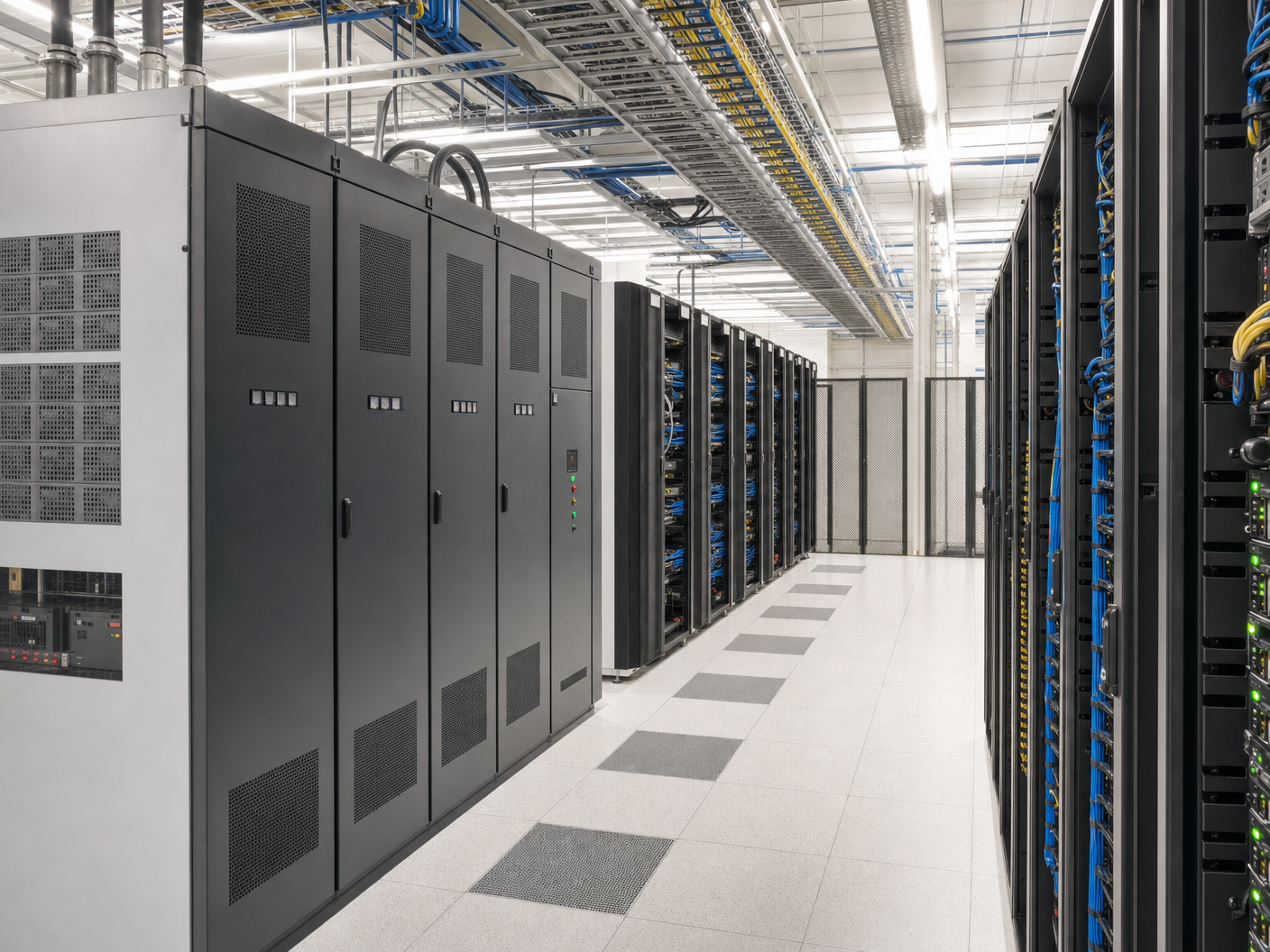
As data centers evolve to support AI training and large-scale cloud services, the power density per rack is increasing significantly. This shift brings several power quality challenges to the forefront. Non-linear loads, such as switch-mode power supplies (SMPS) in servers and Uninterruptible Power Supply (UPS) systems, generate significant harmonic currents. At the same time, precision cooling systems—essential for high-density computing—use Variable Frequency Drives (VFDs) that contribute to both harmonics and reactive power demand.
| Power Quality Challenge | Primary Source in Data Centers | Impact on Operations | Standard Compliance |
|---|---|---|---|
| Harmonic Distortion (THDi) | UPS systems, Server PSUs, VFDs in cooling | Transformer overheating, neutral wire overload, data errors | IEEE 519 / IEC 61000 |
| Low Power Factor | Cooling pumps, fans, lightly loaded UPS | Utility penalties, reduced backup generator capacity | Local Grid Codes |
| Voltage Fluctuations | Large motor starts, grid instability | IT equipment reboot, sensitive component damage | IEC 61000-4-30 |
| Phase Unbalance | Uneven distribution of single-phase server loads | Reduced efficiency, negative-sequence currents | ANSI C84.1 |
The Active Harmonic Filter (AHF) is a state-of-the-art solution for mitigating harmonic distortion. Unlike passive filters that are tuned to specific frequencies and can cause resonance, an AHF is an intelligent power electronics device that monitors the load current and injects a precisely calculated counter-harmonic current. This cancels out the distortion, keeping the Total Harmonic Distortion (THDi) typically below 5%.
While many modern “Green” UPS systems claim to have low harmonic injection, real-world data centers often see significant THDi at the UPS input, especially when operating at partial loads or with older IT equipment. High THDi can cause resonance with the distribution system and interfere with the sensitive electronics of the UPS itself. Integrating an AHF at the UPS input or the main distribution panel ensures full compliance with IEEE 519 standards.
Precision cooling is non-negotiable. The VFDs used in pumps and fans are major harmonic sources. Excessive harmonics can cause motor overheating and insulation failure. By applying AHF units to the cooling distribution boards, data center managers can extend the life of their expensive thermal management assets.
For more details on sizing, see our AHF Sizing Guide for VFD Loads.
While AHF focuses on harmonics, the Static Var Generator (SVG) is the premium solution for reactive power compensation and voltage stability. In many data center scenarios, the power factor is “leading” due to the capacitance of extensive cabling and IT loads, or “lagging” due to motors in the infrastructure. Traditional capacitor banks are too slow and can lead to over-compensation or resonance.
The core of an SVG is a three-level NPC (Neutral Point Clamped) topology utilizing high-speed IGBTs. This allows the device to act as a controlled current source. By phase-shifting its output current relative to the grid voltage, it can provide leading or lagging reactive power within one grid cycle. This is particularly vital during transient events, such as when a large chiller starts or during a utility supply dip.
An SVG for data centers provides instantaneous, step-less reactive power compensation from -1.0 to +1.0 power factor. This dynamic response is crucial when the data center switches to backup generator power, where maintaining a stable power factor is essential for generator stability and synchronization. Back-up generators often have a narrow “stable” operating window regarding power factor; an SVG ensures the generator never sees a leading PF that could lead to excitation failure.
| Feature | Active Harmonic Filter (AHF) | Static Var Generator (SVG) |
|---|---|---|
| Primary Function | Harmonic Mitigation (2nd to 50th) | Reactive Power Compensation (PF) |
| Secondary Function | Load Balancing, basic PF correction | Voltage Support, basic harmonic filtering |
| Response Time | < 5 ms (Overall) | < 5 ms (Overall) |
| Topology | Three-level NPC / Shunt | Three-level NPC / Shunt |
| Control Core | DSP + FPGA (Real-time FFT) | DSP + FPGA (Instantaneous Power Theory) |
| Best For | UPS inputs, VFD racks, non-linear IT loads | Main feeders, cooling infrastructure, genset stability |
The performance of any AHF or SVG is only as good as its control system. Elumotive units utilize a dual-core digital architecture combining a Digital Signal Processor (DSP) and a Field Programmable Gate Array (FPGA).
This digital intelligence is what makes a modern converter-based solution superior to legacy magnetic components. It provides self-diagnostic capabilities, 100% current limiting (so the unit never trips on overload), and comprehensive event logging for site audits.
For the ultimate data center electrical protection, Elumotive recommends a hybrid integration strategy. By combining AHF and SVG, either in separate units or as an integrated Hybrid Var Compensator, data centers achieve comprehensive power quality management.
Learn more about the difference between converter-based and capacitor-based solutions in our article: SVG vs Capacitor Bank.
Energy efficiency is measured by Power Usage Effectiveness (PUE). Poor power quality increases losses in transformers, cables, and distribution equipment. High harmonics lead to skin effect and proximity effect, increasing resistive losses (I²R) in conductors.
Case Study Calculation:
Consider a 10 MW data center with an average THDi of 15% before mitigation. By installing an AHF system to reduce THDi to < 5%, the transformer and distribution losses can be reduced by approximately 1.5%.
– Power Saved: 10,000 kW * 0.015 = 150 kW
– Annual Energy Savings: 150 kW * 8,760 hours = 1,314,000 kWh
– Carbon Reduction: Approx. 900 metric tons of CO2 per year.
These savings directly improve the PUE and significantly reduce operational expenditure (OPEX) over the 15-20 year life of the data center.
Utilities are increasingly strict about harmonic limits. The IEEE 519 standard defines the permitted levels of voltage and current distortion at the Point of Common Coupling (PCC). Failing to meet these limits can result in significant fines or even disconnection from the grid.
| Voltage Level at PCC | Individual Harmonic Limit (%) | Total Harmonic Distortion (THDv) (%) |
|---|---|---|
| V ≤ 1.0 kV | 5.0 | 8.0 |
| 1.0 kV < V ≤ 69 kV | 3.0 | 5.0 |
| 69 kV < V ≤ 161 kV | 1.5 | 2.5 |
| V > 161 kV | 1.0 | 1.5 |
As AI becomes a core load for data centers, it is also becoming a core tool for managing their power. The next generation of power quality solutions, like the SET-iSeries, features AI-integrated monitoring. These systems don’t just react to harmonics; they predict them by analyzing load patterns over time.
For example, by integrating with the DCIM (Data Center Infrastructure Management) system, an AHF can anticipate the “harmonic surge” that occurs when a high-density GPU cluster ramps up for a training job. This predictive compensation minimizes the transient voltage notch that typically occurs, further protecting the power-supply units (PSUs) in the servers.
Furthermore, cloud-based monitoring allows data center operators to track their harmonic compliance (IEEE 519) in real-time across multiple global sites from a single dashboard. This level of visibility is becoming a standard requirement for “Uptime Institute Tier IV” certified facilities.
When selecting a power quality solution for your data center, consider the following checklist:
Yes. AI training involves highly fluctuating loads as GPUs spin up and down. This requires the millisecond-level response time of an SVG/AHF system to prevent voltage sags and flicker that could crash the training job.
Absolutely. In fact, they are often required. High harmonic levels can interfere with the generator’s AVR (Automatic Voltage Regulator), leading to unstable voltage or generator shutdown.
A “mixed” strategy is often best: mitigate large loads (like main cooling plant VFDs) at the source and provide overall cleanup at the main distribution panel to protect the entire facility.
Shanghai Elumotive Technology specializes in custom-engineered AHF and SVG solutions for high-availability environments. From initial site surveys and harmonic studies to modular hardware delivery and commissioning, our engineers ensure your data center power infrastructure is future-proof. We also offer medium-voltage STATCOM solutions for the largest hyper-scale campuses.
Email: sales@elumotive.com
Tel: +86 182 0194 9796
Location: Shanghai, China
Request a Data Center Power Quality Study → or browse our Product Catalog.