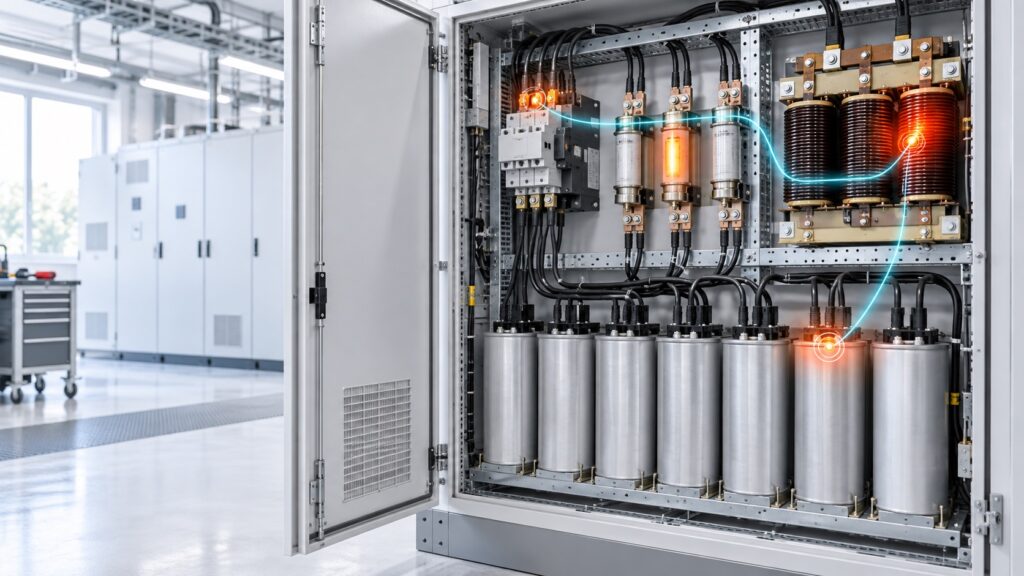
Capacitor bank overheating or repeated fuse operation is a warning, not a maintenance routine. Replacing the failed part without identifying the electrical cause often leads to another failure. The investigation should cover harmonics, voltage, switching, ventilation, connection quality and the coordination of every component in the compensation stage.
Follow the site’s lockout, discharge and verification procedure. Look for bulging cases, discoloration, damaged contactors, overheated conductors, dust accumulation and loose hardware. Confirm that discharge time has elapsed before touching components. Record the failed phase and stage because the pattern may reveal a connection or control problem.
| Check | Useful evidence | Possible action |
|---|---|---|
| Voltage and current | Trend for each phase and stage | Correct overvoltage or imbalance |
| Harmonic spectrum | Voltage and current by order | Detune the bank or add active filtering |
| Temperature | Thermal scan and ambient measurement | Repair cooling and connections |
| Switching log | Operations per stage and transient events | Adjust controller or switching technology |
| Capacitance | Measured value versus nameplate | Replace degraded units as a matched set |
A detuned reactor can reduce resonance risk, but it changes capacitor voltage, current and kvar. The reactor percentage and capacitor rating must be selected as a pair. Review detuned reactor selection and the low-voltage capacitor guide before modifying an existing bank.
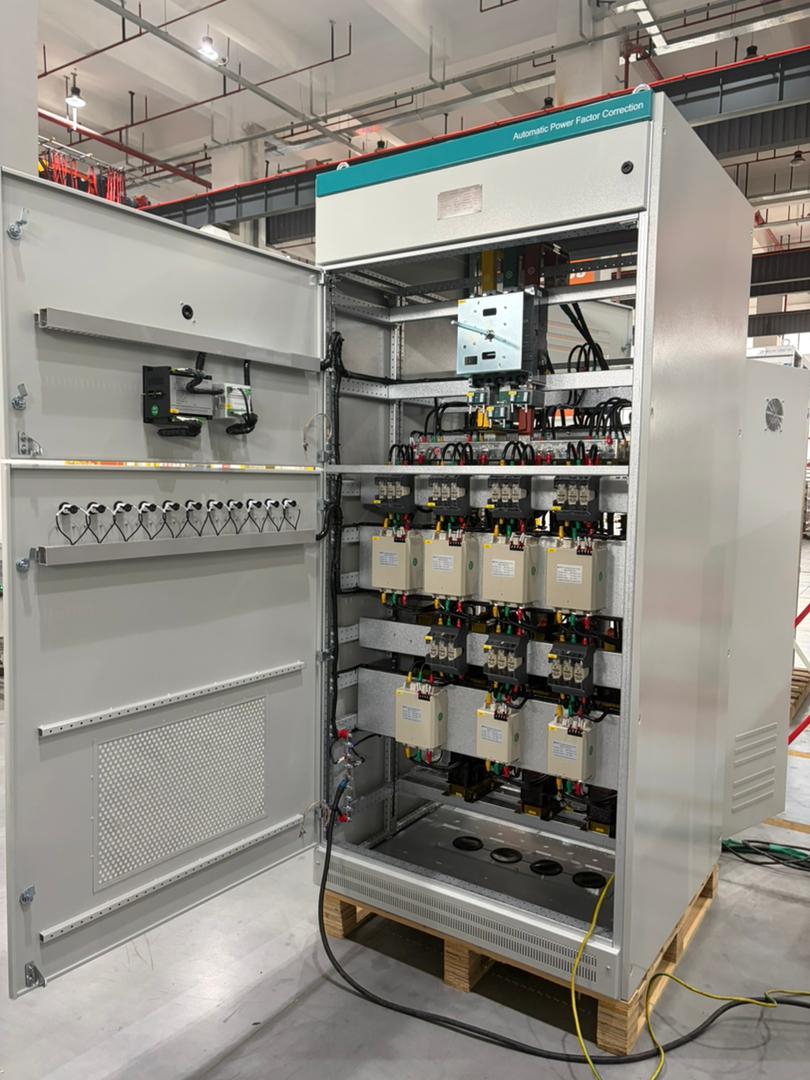
If significant harmonic current comes from variable nonlinear loads, an AHF can reduce the current flowing into the capacitor system. If reactive demand changes too quickly for contactor-switched stages, an SVG can handle the dynamic part. A hybrid design can retain economical base kvar while reducing switching stress.
Begin with a safe visual and thermal inspection before replacing fuses. Record phase currents, capacitor step currents, contactor condition, terminal torque, ventilation path and cabinet temperature. Compare the actual capacitor current with the nameplate value and check individual harmonic voltage and current. Repeated fuse operation can indicate a failed can, loose connection, inrush problem, harmonic overload or resonance; replacing the fuse alone can hide the root cause.
Test the bank with representative plant loads and document which steps are connected when overheating appears. Review reactor inductance, capacitor capacitance and protection coordination if a detuned bank is installed. When measurements show elevated background harmonics, compare the system at the point of common coupling with the relevant IEEE 519 information. A structured inspection prevents repeated capacitor bank overheating and supports a durable corrective design.
Increasing the fuse rating without a coordination study can remove protection and increase damage. Find the current and thermal cause first.
No. Ventilation, connections, reactors, contactors and harmonic current can all produce heat.
Test capacitance, current and insulation, then follow the manufacturer and project maintenance criteria. Mixed aging states may justify replacing matched groups.
Elumotive can review stage ratings, photos, harmonic measurements and failure history to identify a practical correction path. Send the project data.