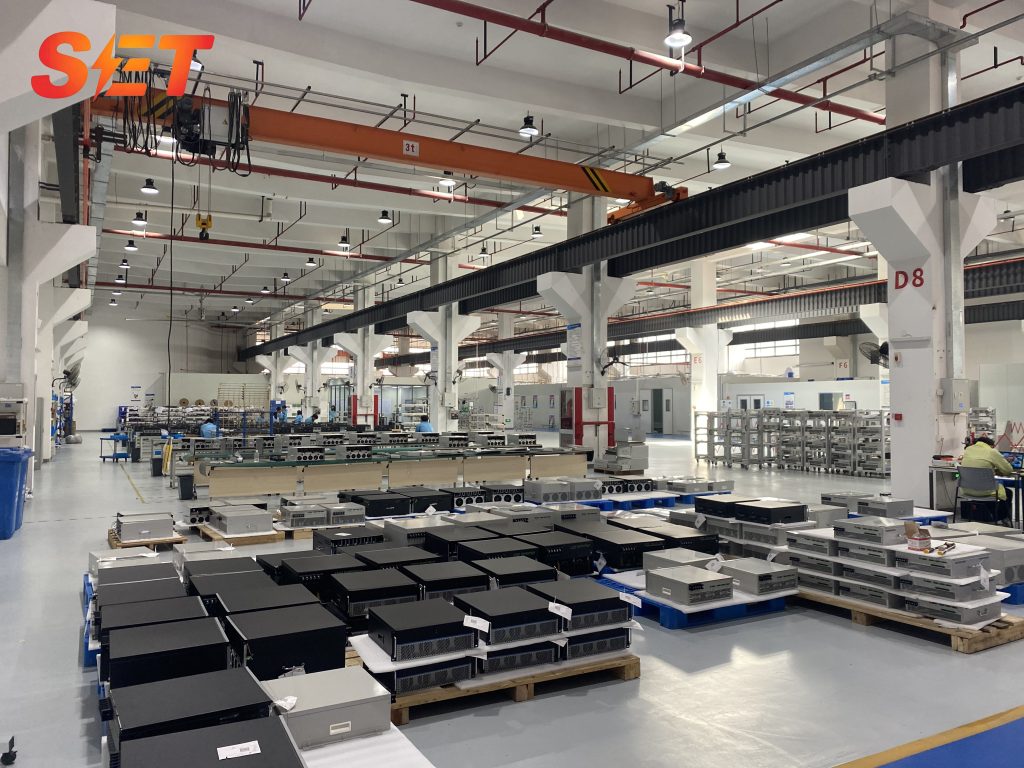
Choosing the right low voltage power capacitor is essential for stable power-factor correction, lower electrical losses and reliable operation of industrial distribution systems. A capacitor that is incorrectly selected may deliver insufficient reactive-power compensation, overheat during operation or create resonance problems with harmonic-producing loads.
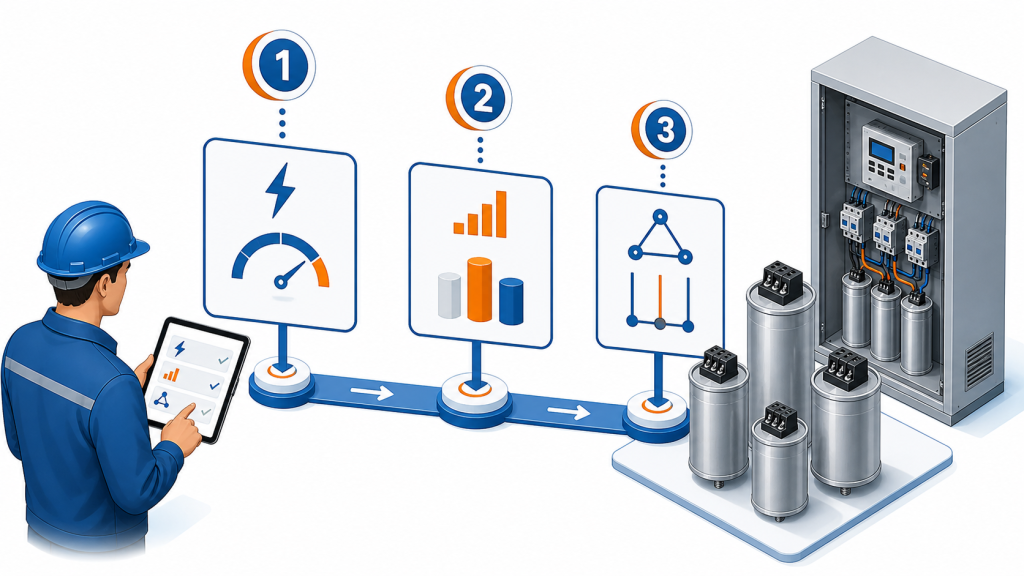
Before purchasing a power factor correction capacitor, engineers should evaluate the system voltage, required kVAR, phase connection, harmonics, switching method and safety features. This practical guide explains how to choose a low voltage power capacitor for factories, commercial buildings and distribution panels.
A low voltage power capacitor supplies reactive power locally to compensate for inductive loads such as motors, transformers, pumps and compressors. By reducing the reactive current drawn from the utility, a capacitor bank can improve power factor and make better use of existing electrical infrastructure.
Low voltage power capacitors may be installed individually, in automatic capacitor banks or as part of a hybrid reactive-power compensation system.
Rated voltage is one of the most important selection factors. The capacitor voltage rating must match the electrical system and the expected operating conditions.
| System voltage | Typical application | Selection consideration |
|---|---|---|
| 250V / 280V / 300V 3YN | Three-phase low-voltage systems | Confirm star connection and neutral configuration |
| 400V / 415V | Standard industrial distribution | Check voltage fluctuation and switching duty |
| 450V / 480V | Industrial and commercial panels | Suitable for higher operating voltage margins |
| 525V | Higher-voltage low-voltage systems | Often selected where additional voltage margin is required |
Never select a capacitor only by its nominal voltage. Also consider voltage fluctuation, harmonic voltage, ambient temperature and continuous operating conditions. A 525V power capacitor may provide additional voltage margin, but the actual kVAR output and controller settings must be verified for the target system.
See the SET 525V power capacitor and 480V power capacitor product ranges.
The capacitor capacity must be large enough to correct the power factor without causing overcompensation. A commonly used calculation is:
Qc = P × (tan φ₁ − tan φ₂)
In this formula, Qc is the required capacitor capacity in kVAR, P is active power in kW, φ₁ is the initial power-factor angle and φ₂ is the target power-factor angle.
For example, if an industrial load consumes 500 kW at a power factor of 0.78 and the target power factor is 0.95, the calculated compensation requirement is approximately 237 kVAR. The final design should also consider load variation, transformer capacity, existing capacitor steps, harmonic distortion, future load growth and minimum off-peak load.
Several smaller automatic capacitor steps are usually more flexible than one oversized fixed capacitor. Automatic switching allows the compensation system to follow changing reactive-power demand.
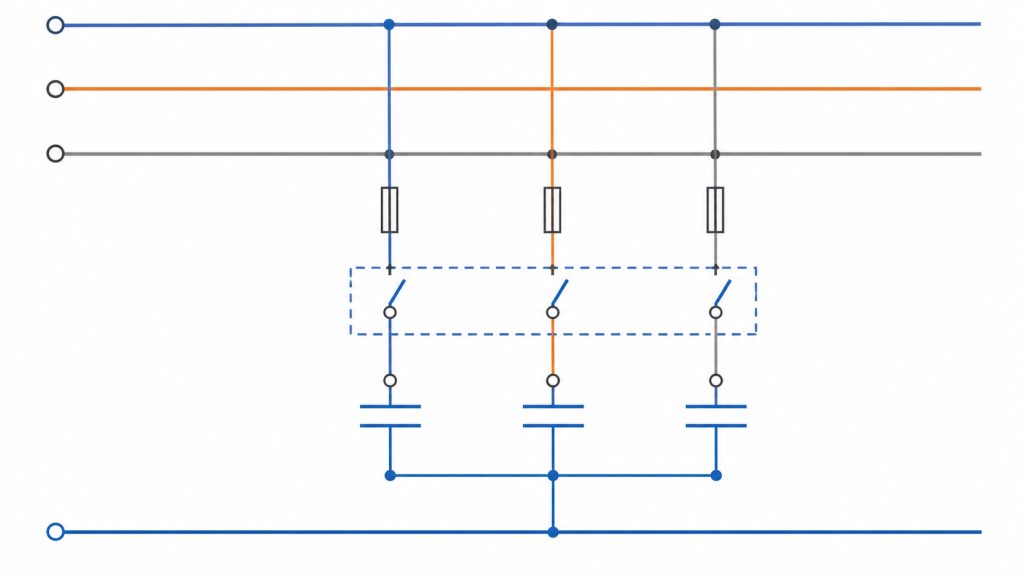
The electrical connection must match the distribution system. Common configurations include three-phase three-wire, three-phase four-wire, delta-connected, star-connected and 3YN systems.
A 3YN low voltage power capacitor is designed for specific three-phase systems where the neutral and phase-to-neutral voltage must be considered. Always confirm the wiring diagram, insulation level and control method before installation.
SET 3YN low voltage power capacitor for balanced three-phase systems
For 3P4W systems, also consider phase imbalance and neutral current. A capacitor bank alone may not solve severe current imbalance; an SVG or active compensation device may be required.
Capacitors can interact with harmonic-producing equipment such as variable-frequency drives, UPS systems, welding machines, rectifiers, data-center power supplies and arc furnaces.
If harmonic distortion is present, installing an unprotected capacitor bank may create parallel resonance and increase voltage or current distortion. Before selecting a power factor correction capacitor, measure THDv, THDi, dominant harmonic orders, load current, transformer impedance and existing capacitor-bank conditions.
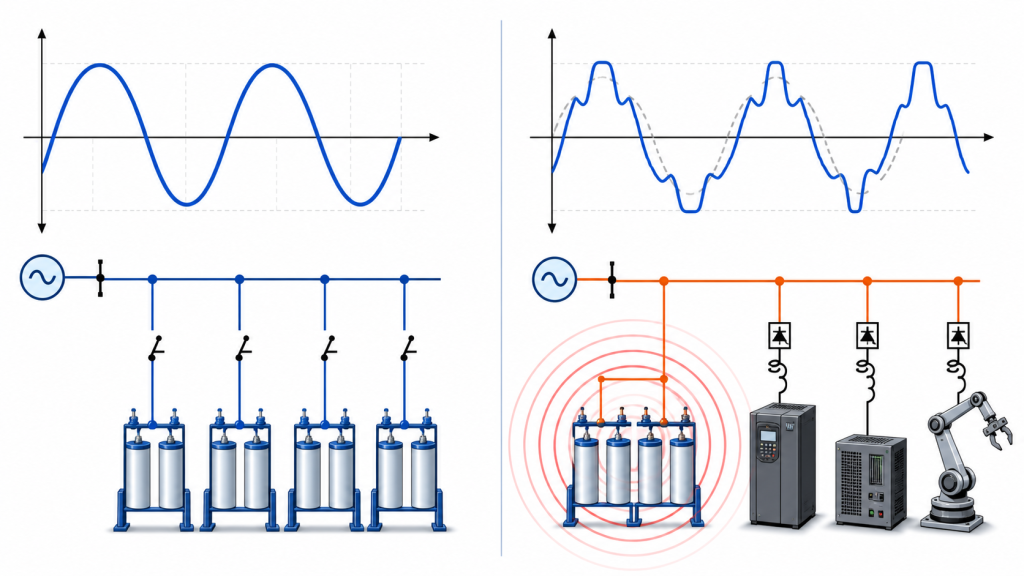
For systems with significant harmonics, consider detuned reactors, active harmonic filters or a hybrid SVG and capacitor solution. A capacitor bank provides reactive-power compensation; it is not a replacement for an active harmonic filter.
A reliable low voltage power capacitor should include appropriate internal and external protection.
Self-healing technology allows a small dielectric breakdown area to isolate itself during operation. This helps the capacitor continue operating safely without an immediate total failure. However, self-healing does not eliminate the need for correct protection, ventilation and periodic inspection.
Contactor-switched capacitor banks are suitable for loads with gradual or predictable reactive-power changes. They are cost-effective and common in factories, buildings and pump systems.
Thyristor-switched capacitor banks are better for rapidly changing loads. They provide fast switching with reduced mechanical wear and are useful for cranes, welding lines and fluctuating production equipment.
A hybrid system combines capacitors for base reactive-power demand with SVG technology for fast and precise compensation. This configuration can improve response time while keeping the overall investment under control.
It may be possible, but the available kVAR output changes with operating voltage. The control settings and required compensation capacity must be checked before installation.
No. Capacitors primarily provide reactive-power compensation. Systems with significant harmonics may require an active harmonic filter or a detuned capacitor-bank design.
The decision depends on system voltage, operating margin, harmonic conditions, required kVAR and the manufacturer’s technical recommendations.
Always confirm the applicable project requirements and product documentation. IEC guidance for low-voltage capacitor design and testing can be found through the International Electrotechnical Commission.
Selecting the correct low voltage power capacitor requires more than matching a voltage and kVAR number. Engineers should evaluate system voltage, load profile, phase connection, harmonic distortion, switching method and protection requirements together.
SET offers 450V, 480V, 525V and 3YN capacitor solutions for different low-voltage distribution systems. Contact our technical team for capacitor-bank sizing, wiring guidance and application-specific recommendations.