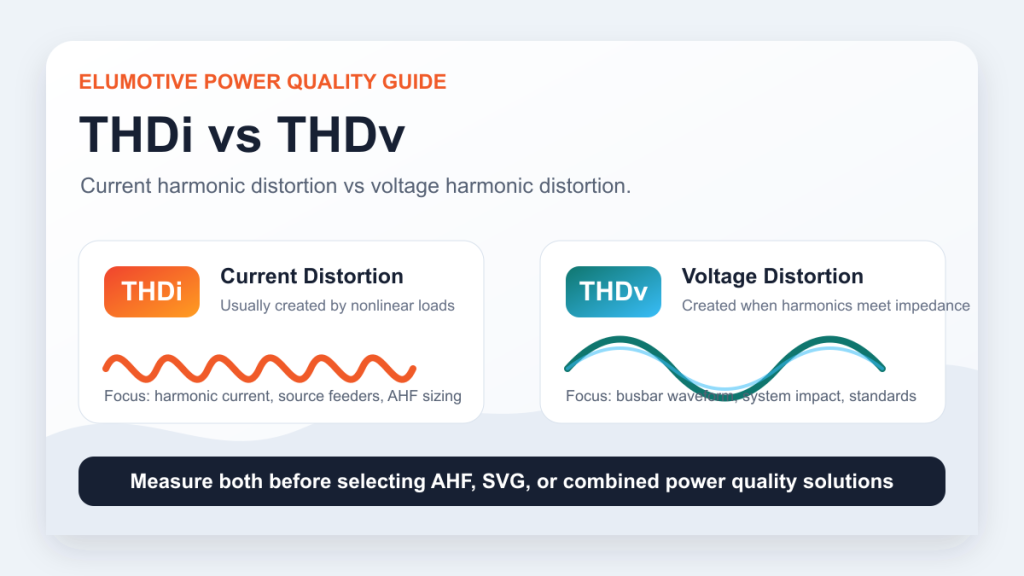
THDi means total harmonic distortion of current. THDv means total harmonic distortion of voltage. The simple difference is this: THDi tells engineers how distorted the current waveform is, while THDv tells engineers how distorted the voltage waveform is. In most power quality projects, nonlinear loads such as VFDs, UPS systems, rectifiers and EV chargers create harmonic current first. That harmonic current then flows through system impedance and may create voltage distortion. For this reason, engineers should review both THDi and THDv before selecting an Active Harmonic Filter, Active Power Filter, SVG or other power quality solution.
THDi describes current waveform distortion. THDv describes voltage waveform distortion. Both are important in harmonic analysis.
Shanghai Elumotive Technology and Elumotive support industrial power quality projects involving Active Harmonic Filter, Active Power Filter, Static Var Generator, SVG, STATCOM, harmonic mitigation and reactive power compensation. This guide explains the practical difference between THDi and THDv, how they are related, and what measurement data engineers should collect.
THDi stands for Total Harmonic Distortion of current. It measures how much harmonic current exists compared with the fundamental current.
In a 50 Hz system, the fundamental current is the 50 Hz component. Harmonic current appears at higher frequencies, such as:
In many three-phase industrial systems, the 5th, 7th, 11th and 13th harmonics are especially common when variable frequency drives or rectifier loads are used.
High THDi usually means the load is drawing current in a distorted waveform. It does not always mean the voltage is already severely distorted, but it tells engineers that harmonic current is present and should be evaluated.
THDv stands for Total Harmonic Distortion of voltage. It measures how much harmonic voltage exists compared with the fundamental voltage.
Voltage distortion is important because many devices connected to the same electrical system depend on a stable voltage waveform. If THDv becomes too high, sensitive equipment may experience overheating, malfunction, nuisance alarms or reduced reliability.
THDv is often influenced by three things:
A strong electrical system with low impedance may tolerate harmonic current with lower voltage distortion. A weaker system may show higher THDv even when the harmonic current source is similar.
| Item | THDi | THDv |
| Full name | Total harmonic distortion of current | Total harmonic distortion of voltage |
| What it describes | Distortion in the current waveform | Distortion in the voltage waveform |
| Main source | Nonlinear loads drawing pulsed current | Harmonic current flowing through system impedance |
| Common concern | Transformer heating, cable losses, capacitor stress, harmonic current injection | Sensitive equipment issues, voltage waveform quality, system-wide disturbance |
| Typical measurement point | Load feeder, main panel, point of common coupling | Busbar, main panel, point of common coupling |
| Common related equipment | VFD, UPS, rectifier, EV charger, welding machine | Transformer, cables, utility source, weak grid conditions |
| Typical mitigation | Active Harmonic Filter, Active Power Filter, line reactor, passive filter | Reduce harmonic current, improve system design, increase short-circuit strength |
| Standard references | IEEE 519, IEC 61000 project requirements | IEEE 519, IEC 61000 voltage distortion limits |
It is possible to measure high THDi at a load feeder while THDv remains acceptable at the main busbar. This happens when the electrical system is strong enough that harmonic current does not create serious voltage distortion.
For example, a group of VFDs may draw distorted current and show high THDi on the feeder. But if the transformer has sufficient capacity and the upstream system has low impedance, the voltage waveform may still remain relatively clean.
This does not mean high THDi can be ignored. Harmonic current can still increase transformer losses, cable heating and stress on capacitor banks. It also may become a future problem when more nonlinear loads are added.
THDv deserves special attention because voltage is shared by all loads connected to the same busbar. A nonlinear load may create harmonic current, but the resulting voltage distortion can affect equipment that did not create the harmonics.
This is why engineers often check THDv at the main distribution panel or point of common coupling. If voltage distortion is high, the issue is no longer limited to one machine or one feeder. It may affect PLCs, drives, control systems, UPS equipment, communication devices and other sensitive loads.
Assume a factory has one 1600 kVA transformer and several VFD-driven production lines. A power quality analyzer records the following data during normal operation:
| Measurement Item | Value | Meaning |
| Load current at main panel | 900 A | Current base for harmonic review |
| Current THDi | 28% | Significant harmonic current exists |
| Voltage THDv | 3.2% | Voltage distortion is present but not extreme |
| Dominant harmonic orders | 5th and 7th | Typical VFD rectifier pattern |
| Existing capacitor bank | Yes | Resonance risk should be checked |
In this case, the first engineering conclusion is that harmonic current is the main source. An Active Harmonic Filter may be considered to reduce THDi. The existing capacitor bank should also be reviewed because capacitor banks can be affected by harmonic resonance.
If THDv later increases above the project target, reducing harmonic current at the source or at the main panel becomes even more important.
A useful way to think about the relationship is:
Nonlinear loads create harmonic current. Harmonic current flowing through system impedance creates harmonic voltage.
This means THDi and THDv are connected, but they are not the same measurement. High THDi is often the cause side. THDv is often the system response side.
The same nonlinear load may produce different THDv levels in different electrical systems. A weak grid, long cable run, small transformer or high impedance network can make voltage distortion worse.
Common causes of high THDi include:
These loads do not draw current in a perfect sine wave. Their input stage often draws current in pulses, creating harmonic current components.
For VFD-specific guidance, read: Active Harmonic Filter for VFD Loads: How to Reduce THDi in Industrial Power Systems
High THDv may appear when harmonic current interacts with electrical system impedance. Common contributing factors include:
When THDv is high, engineers should not only look at one load. They should review the complete power system: transformer, cables, capacitor bank, harmonic source locations and upstream supply conditions.
Engineers should review both, but the priority depends on the problem.
If the goal is to identify harmonic sources, THDi is usually the first focus. It shows which feeders or loads are injecting harmonic current.
If the goal is to evaluate the quality of the power supplied to equipment, THDv becomes very important. It shows how distorted the voltage waveform is at a busbar or point of common coupling.
For power quality equipment selection:
For a broader solution comparison, see: Active Harmonic Filter vs Static Var Generator: What Is the Difference?
An Active Harmonic Filter or Active Power Filter measures harmonic current in real time and injects opposite harmonic current to cancel it. The main target is current distortion, so AHF selection is usually based on harmonic current demand rather than only transformer capacity.
By reducing harmonic current, an AHF can also help improve upstream waveform quality and reduce the risk of voltage distortion, transformer heating, capacitor stress and nuisance tripping.
However, if the main issue is low power factor or rapidly changing reactive power, a Static Var Generator, SVG or STATCOM may be needed. In many industrial projects, AHF and SVG are used together because nonlinear loads and reactive power demand appear at the same time.
Before selecting a harmonic mitigation solution, collect:
This data helps determine whether the site needs AHF, SVG, capacitor/reactor modification, system redesign or a combined power quality solution.
Neither is always more important. THDi is important for identifying harmonic current sources and sizing harmonic mitigation equipment. THDv is important for understanding voltage waveform quality and the impact on the whole electrical system.
Yes. A strong power system with low impedance may have high current distortion from nonlinear loads while voltage distortion remains within the project target. The harmonic current still needs review because it may affect transformers, cables and capacitor banks.
An Active Harmonic Filter mainly reduces harmonic current. By reducing harmonic current flowing through system impedance, it may also help lower voltage distortion. The final THDv improvement depends on system impedance, harmonic sources and installation point.
For many three-phase VFD and rectifier systems, engineers often check the 5th, 7th, 11th and 13th harmonics. The 3rd harmonic may also be important in systems with many single-phase nonlinear loads.
An SVG is mainly used for dynamic reactive power compensation and power factor improvement. It is not the primary device for harmonic current mitigation. If THDi is the main issue, an Active Harmonic Filter is usually the more suitable solution.
Send the power quality report, voltage level, transformer capacity, load current, THDi, THDv, harmonic spectrum, power factor, capacitor bank information and application details. Elumotive can use this data to recommend an initial power quality solution.
THDi and THDv are related but different power quality measurements. THDi describes current distortion, usually caused by nonlinear loads. THDv describes voltage distortion, usually caused when harmonic current flows through system impedance.
For practical harmonic mitigation, engineers should not rely on only one number. THDi, THDv, individual harmonic orders, power factor, reactive power demand and capacitor bank conditions should be reviewed together.
If your site has high THDi, high THDv, capacitor bank problems, transformer heating or unstable power quality, contact Elumotive for an engineering review.
CTA: Send your voltage level, transformer capacity, load current, THDi/THDv report, harmonic spectrum and application details to Elumotive for an initial power quality solution recommendation.
Contact: sales@elumotive.com
Website: https://www.elumotive.com