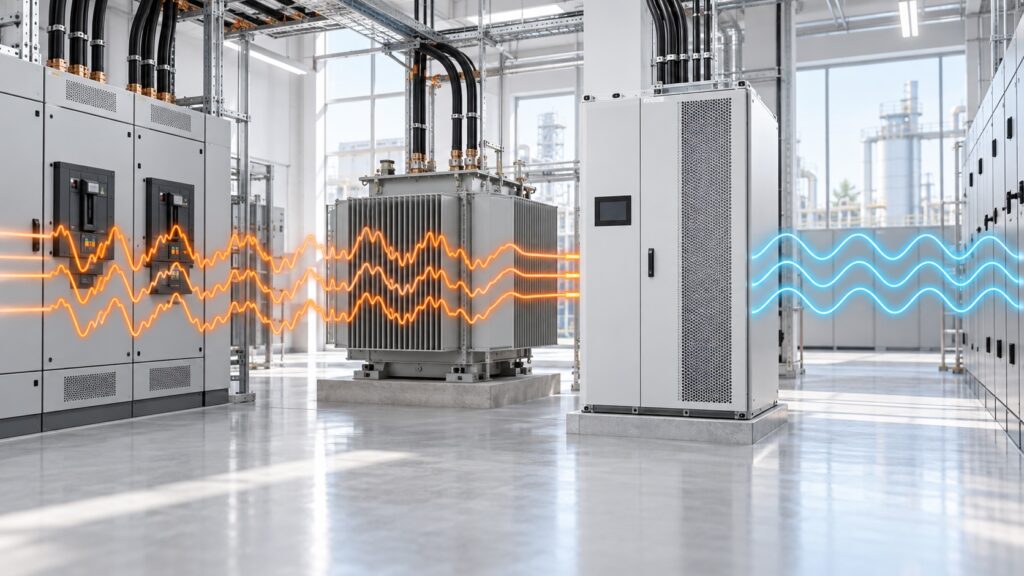
480V industrial systems commonly supply VFDs, rectifiers, UPS systems, welders and automated production lines. Selecting an active harmonic filter for this network requires more than matching the voltage on a product sheet. The design must reflect measured harmonic current, the grounding and line arrangement, CT location and expected plant growth.
| Design input | Selection impact |
|---|---|
| 480V, 60Hz | Defines the voltage and frequency class |
| 3P3W or 3P4W | Determines whether neutral-current compensation is required |
| Transformer kVA and impedance | Supports fault-level and system-strength assessment |
| Main and branch load current | Identifies the practical connection point |
| Harmonic amperes by order | Determines compensation demand |
| Ambient and enclosure | Defines cooling, IP/NEMA coordination and installation space |
Central compensation at the main bus can address many variable loads with one system. Local compensation near a large nonlinear load prevents harmonic current from flowing through upstream feeders. The best location is often found by comparing the harmonic contribution of each feeder and the cost of cable, breakers and downtime.
CT polarity and phase sequence are critical. Incorrect CT placement can cause poor compensation or alarms even when the current rating is correct. Use the AHF installation and commissioning guide to prepare the work.
Record individual harmonic amperes at normal and peak production. Consider load diversity: not every drive operates at full load at the same time. Add growth margin for confirmed future equipment, but avoid sizing the filter from transformer full-load current alone. Modular designs can provide a practical expansion path when production plans are uncertain.
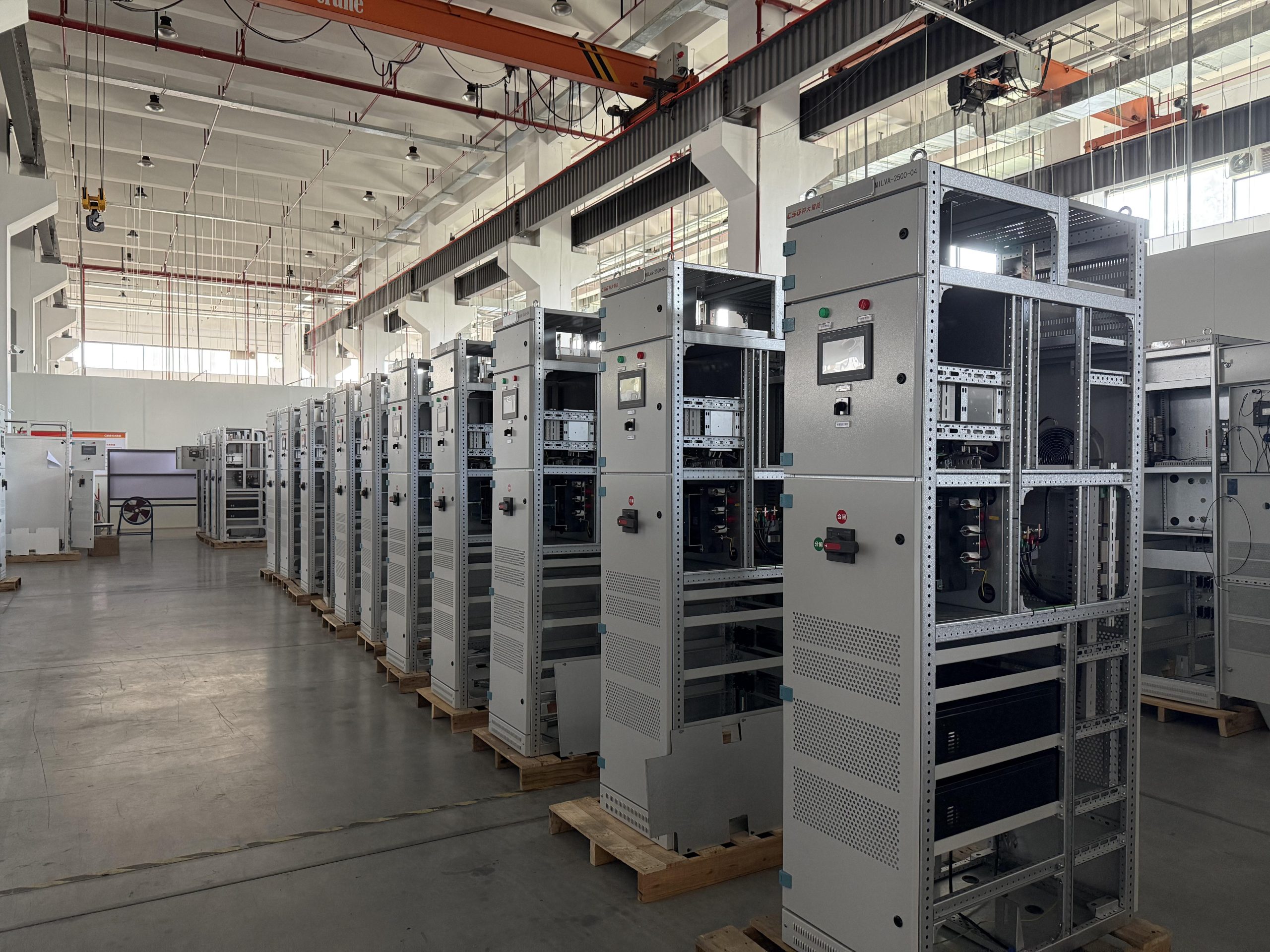
Before purchase, confirm that the 480V active harmonic filter can deliver its continuous current rating at the site temperature and altitude. The design review should cover CT ratio and polarity, 3P3W or 3P4W wiring, feeder breaker rating, available panel space, heat rejection and communication protocol. Define the harmonic orders to be compensated and the load conditions used for the acceptance test. Measure baseline and post-installation results at the same location and production state.
For US projects, also review the complete panel construction, short-circuit rating, grounding and field wiring with the local authority having jurisdiction. The filter specification should align with the plant safety process and applicable UL 508A industrial control panel guidance. These checks reduce commissioning delays and make supplier quotations easier to compare.
No. Four-wire compensation is relevant when the system has a neutral and significant zero-sequence or triplen harmonic current. The network and load mix determine the choice.
Yes, if the CT and connection point measure the combined current and the rating covers simultaneous operation. Local problems may still justify feeder-level units.
Confirm the project’s required codes, listings, short-circuit ratings and enclosure standards with the local engineer and authority. Do not assume that a general product description satisfies a project-specific requirement.
Elumotive can review your 480V single-line diagram, analyzer export and load schedule to prepare an initial configuration. Request a project review.