
Summary
A nonwoven textile manufacturer was experiencing severe harmonic distortion across its low-voltage distribution system. Variable-frequency drives and electronically controlled production machinery generated a complex harmonic spectrum, causing the existing capacitor compensation cabinet to operate abnormally and exposing other electrical equipment to additional stress.
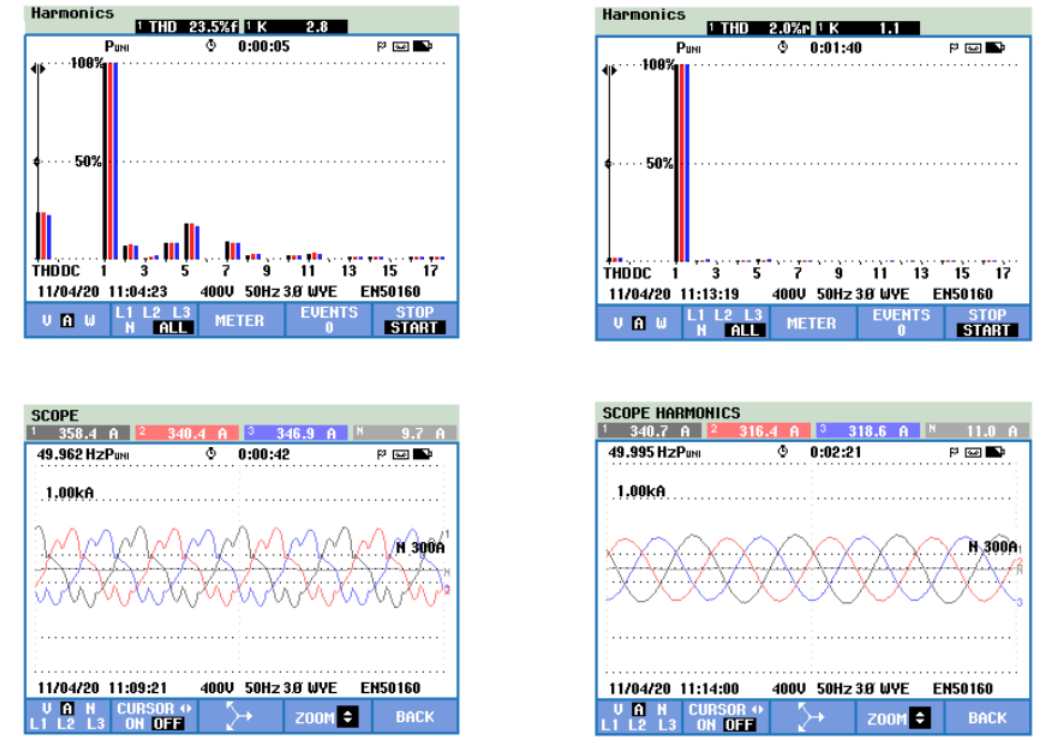
Power-quality measurements recorded a voltage harmonic distortion rate (THDv) of 5.9% and a total harmonic current distortion rate (THDi) of 23.5%. The 3rd, 5th, and 7th orders were the dominant harmonic components, accompanied by smaller amounts of 2nd- and 4th-order distortion.
SET applied a 300 A Active Harmonic Filter cabinet to provide dynamic harmonic compensation under changing production loads. Following commissioning, THDv fell to 2.2%, THDi was reduced to 2.0%, and the current waveform returned to a near-sinusoidal shape. The improvement created better operating conditions for the capacitor compensation cabinet and the wider electrical network.
Manufacturing Context and Harmonic Assessment
The facility’s extensive use of power-electronic controls improved production flexibility but introduced nonlinear current into the distribution network. Because operating combinations and production demand varied throughout the working cycle, the harmonic conditions required a solution capable of responding continuously rather than compensating for one fixed load state.
| Parameter | Recorded Condition |
|---|---|
| Facility type | Nonwoven textile manufacturing plant |
| Principal nonlinear loads | Carding machines, needle-punching machines, nonwoven ovens, and winding machines |
| Additional loads | Variable-frequency ventilation, air conditioning, lighting, and DC equipment |
| THDv before treatment | 5.9% |
| THDi before treatment | 23.5% |
| Dominant harmonics | 3rd, 5th, and 7th orders |
| Additional harmonic content | Smaller 2nd- and 4th-order components |
| Existing operational issue | Capacitor compensation cabinet could not operate normally |
300A AHF Solution
A 300 A Active Harmonic Filter cabinet was installed at the distribution level. Instead of applying a fixed compensation value, the AHF monitors load current in real time, separates harmonic components from the fundamental current, and injects an opposing current to cancel the measured distortion.
Its output automatically follows changes in production demand. Compensation increases when harmonic-producing loads operate together and adjusts again as the load pattern changes, allowing one system to respond to multiple operating states without altering the production machinery.
The selected capacity was intended to improve the electrical conditions supporting both the plant distribution network and its existing capacitor compensation equipment.
Measured Performance
Post-commissioning measurements confirmed a marked improvement in voltage and current quality. Voltage distortion moved below the referenced 5% limit, while current distortion was reduced to a low residual level. The current waveform also changed from a visibly distorted profile to a near-sinusoidal shape.
| Performance Indicator | Before AHF | After AHF |
|---|---|---|
| Voltage harmonic distortion, THDv | 5.9% | 2.2% |
| Total harmonic current distortion, THDi | 23.5% | 2.0% |
| Current waveform | Distorted | Near-sinusoidal |
Operational Value
Reducing harmonic distortion improved the electrical environment supporting the production line. Most importantly, the existing capacitor compensation cabinet could operate under more suitable power-quality conditions instead of being disrupted by high harmonic content.
Lower distortion also reduces the harmonic-heating burden placed on motors, transformers, switchgear, cables, protective devices, and fuses. For a textile plant built around continuous machine operation, this supports network reliability while helping limit avoidable electrical stress and maintenance exposure.
The project demonstrates the value of matching dynamic compensation to actual site conditions. By adapting its output to variations in production demand, the 300 A AHF addressed harmonic distortion through one coordinated solution.
FAQ
Q: What caused the harmonic distortion at the textile plant?
A: The main sources were variable-frequency drives, rectifiers, DC equipment, and electronically controlled machinery operating across the production line.
Q: How did the harmonics affect plant operation?
A: The distortion prevented the existing capacitor compensation cabinet from operating normally. It also created conditions associated with additional heating and electrical stress in motors, transformers, switchgear, cables, fuses, and protective devices.
Q: What did the site measurements show?
A: Before treatment, THDv was 5.9% and THDi was 23.5%. The spectrum was dominated by the 3rd, 5th, and 7th harmonics, with smaller 2nd- and 4th-order components.
Q: Why was a dynamic filter used instead of fixed compensation?
A: Textile production demand changes throughout the operating cycle. A dynamic AHF can follow those variations in real time and adjust its compensating current to the harmonic demand present at each moment.
Q: What AHF capacity was installed?
A: The installation used a 300 A Active Harmonic Filter cabinet.
Q: What improvements were measured after commissioning?
A: THDv decreased from 5.9% to 2.2%, while THDi dropped from 23.5% to 2.0%. The current waveform also returned to a near-sinusoidal shape.
Need a Power Quality Solution?
Send voltage level, transformer capacity, load type, THDi, THDv, power factor, and installation requirements.