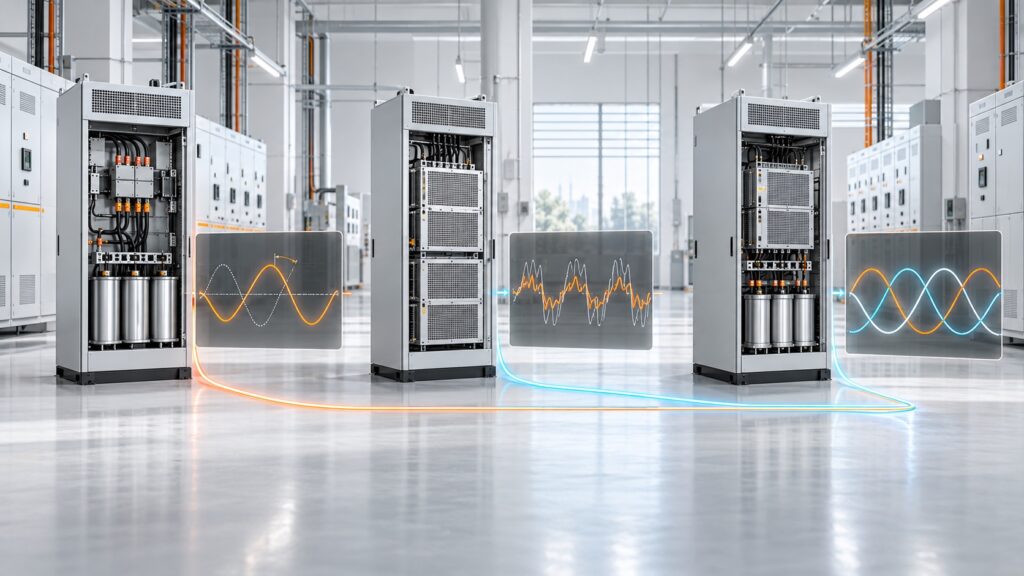
A low power factor, high THDi and phase unbalance can appear in the same power quality report, but they are different problems. A static var generator is designed for fast reactive-power compensation and phase balancing. An active harmonic filter is designed to cancel harmonic current. A hybrid system combines functions when the load profile requires both.
| Observed problem | Primary technology | Engineering check |
|---|---|---|
| Rapidly changing lagging or leading kVAR | SVG | Reactive-power range and response profile |
| High fifth, seventh or higher harmonic current | AHF | Harmonic amperes by order |
| Steady base reactive demand | Detuned capacitor bank | Resonance and capacitor voltage |
| Harmonics plus variable kVAR | AHF + SVG | Independent current allocation |
| Steady and dynamic kVAR plus harmonics | Capacitors + SVG + AHF | Coordinated control and CT plan |
An SVG can improve displacement power factor and correct phase imbalance by producing controlled fundamental-frequency current. Harmonic current requires a different reference and control objective. If a project asks an SVG to solve high THDi without an explicit harmonic function and rating, the power factor may improve while the current waveform remains distorted.
Use THDi vs THDv to separate the measurements and the industrial power-factor guide to understand reactive demand.
Some active filters can provide a degree of reactive compensation, but assigning large steady kVAR demand to an AHF may not be the best use of converter current. When the site has a predictable base load, detuned capacitors can supply economical steady kVAR while the active equipment handles changing demand and distortion.
The hybrid VAR sizing guide explains how to divide the reactive component.
Start with time-synchronised trends for reactive power, phase current and harmonic current. An SVG should be selected from the fastest repeatable kVAR demand and imbalance duty. An AHF should be selected from measured harmonic amperes by order at the intended installation point. A hybrid solution needs a control sequence that prevents the devices from competing and reserves each technology for the problem it solves most efficiently.
Before approval, compare CT placement, response time, continuous rating, overload capability, cabinet losses, cooling and communication. Define the baseline and acceptance test at normal and peak production. Harmonic compliance at the point of common coupling should be checked against the project requirement and the relevant IEEE 519 standard information. A clear verification plan turns an SVG vs AHF comparison into a measurable engineering decision.
Yes, when the electrical clearances, cooling, protection, communication and control architecture are designed for the combined system.
The sequence should follow the dominant risk and project plan. The final arrangement must be commissioned as a coordinated system.
Sometimes, but polarity, location, ratio, burden and communication architecture must be confirmed for the chosen controls.
Send Elumotive your harmonic spectrum, kVAR trend and single-line diagram. We can divide the current demand into an initial AHF, SVG and capacitor configuration. Request a hybrid solution review.