

SET PROJECT CASES
Residential Distribution Projects: Static Var Generator Application Benefits
SET experienced in equipping residential distribution networks with proper power quality solutions.
Referenced Residential Project Examples
| Project | Product | Model |
|---|---|---|
| South State Grid, Guangdong Province | Static Var Generator | SETPQC-SVG |
| State Grid, Zhejiang Province | Static Var Generator | SETPQC-SVG |
| Jingcheng Project | Active Harmonic Filter | SETPQC-AHF |
| State Grid, Zhejiang Province | Static Var Generator | SETPQC-SVG |
| Shaoxing Jianhu Project | Static Var Generator | SETPQC-SVG |
| Shaoxing Yangjinghu 7# Project | Static Var Generator | SETPQC-SVG |
| Shanghai Hezhuo Project | Static Var Generator | SETPQC-SVG |
| Yongzhe Project, Zhejiang Province | Static Var Generator | SETPQC-SVG |
| Wynn Properties Tianze House Project | Hybrid Static Var Generator | SETPQC-CSVG |
Projects Requirements and Application Value
Residential distribution networks are low-voltage distribution systems typically connected to the utility grid through 10/0.4 kV transformers. Loads generally operate at three-phase 480 V and single-phase 220 V. These systems primarily supply small-capacity loads, including air conditioners, refrigerators, televisions, and other household appliances.
Most household appliances are nonlinear loads that generate reactive power during operation. For residential distribution networks characterized by small-capacity nonlinear loads and few large impact loads, hybrid reactive power compensation is applied using a Static Var Generator (SVG) together with switched capacitor/reactor compensation units.
| Application Condition | Source-Defined Characteristic |
|---|---|
| Distribution system | Low-voltage residential distribution network connected through 10/0.4 kV transformers |
| Typical operating voltages | Three-phase 480 V and single-phase 220 V |
| Typical loads | Air conditioners, refrigerators, televisions, and other household appliances |
| Load characteristic | Predominantly small-capacity nonlinear loads |
| Compensation approach | Hybrid reactive power compensation using SVG and switched capacitor/reactor units |
Power Quality Issues and Their Impacts
Reactive power is necessary for normal grid and load operation. However, excessive reactive power produces adverse effects in the residential distribution system.
Increased Equipment Capacity Requirements
An increase in reactive power increases system current and apparent power. This increases the required capacity of generators, transformers, conductors, and other electrical equipment.
Increased Line and Equipment Losses
Higher reactive power increases total current. As a result, equipment and line losses increase, as does voltage drop across lines and transformers.
| Power Quality Issue | Distribution-System Effect |
|---|---|
| Excessive reactive power | Increased system current and apparent power |
| Higher current demand | Increased capacity requirements for generators, transformers, conductors, and other electrical equipment |
| Higher total current | Increased equipment and line losses |
| Higher total current | Increased voltage drop in lines and transformers |
Hybrid SVG and Capacitor Compensation Solution
The hybrid dynamic reactive power compensation system consists of two components:
Switched capacitors compensate large-capacity, fixed reactive power. SVG capacity is configured for small-capacity reactive power that changes rapidly.
This hybrid arrangement maintains switching accuracy and response speed while substantially reducing capacitor switching operations. Fewer capacitor switching operations reduce grid impacts during switching and indirectly improve equipment service life.
Compensation Capacity Basis
Hybrid reactive power compensation is widely used in residential distribution networks. Compensation capacity is generally configured at 30% of transformer capacity. SVG capacity and capacitor capacity are then configured according to user requirements.
Configuration Example
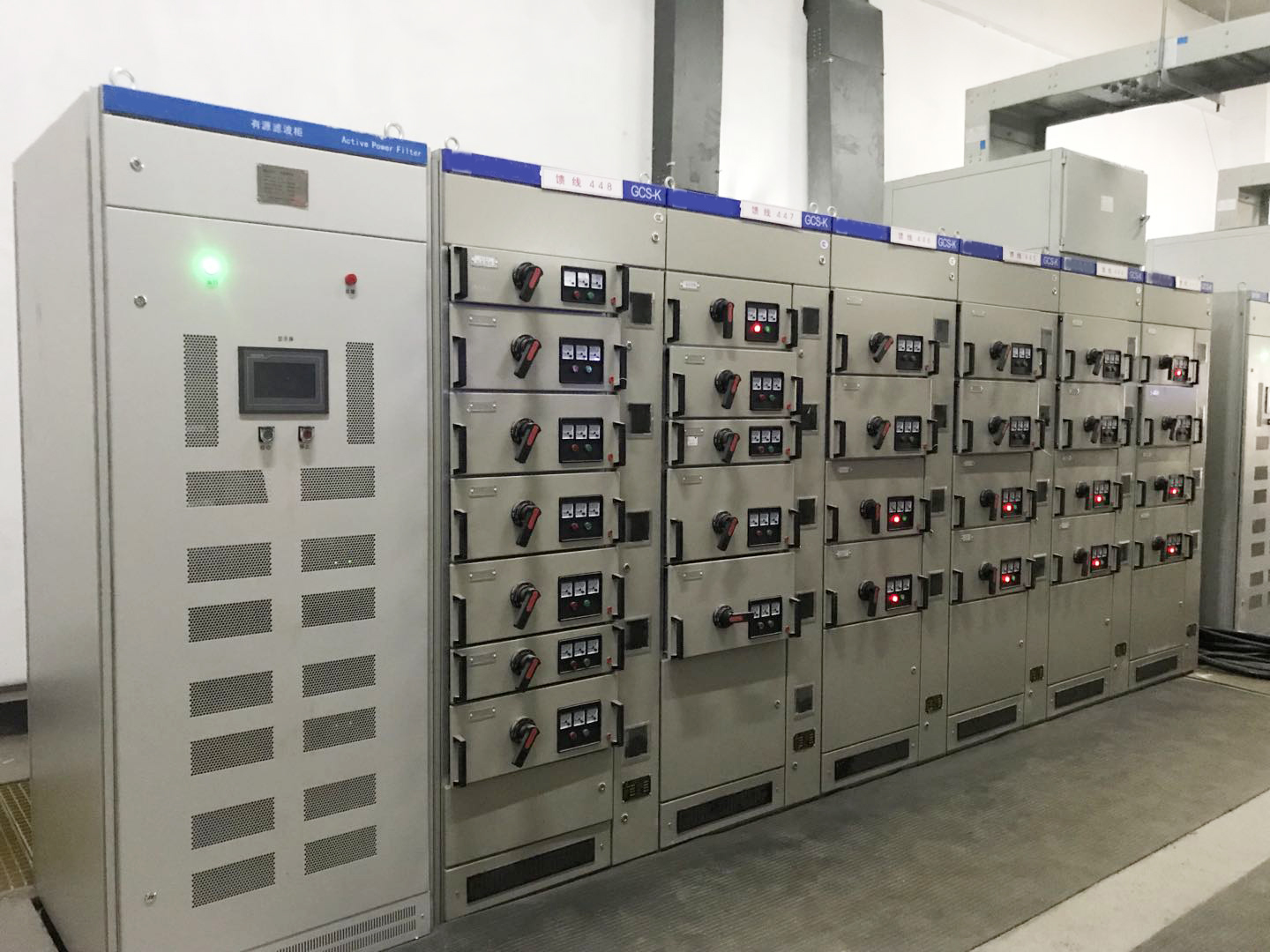
A substation serving a residential community in Shanghai has a transformer capacity of 800 kVA. The site uses a 240 kVAr SETPQC-CSVG hybrid dynamic, real-time power factor compensation device.
| Configuration Item | Installed Value |
|---|---|
| Transformer capacity | 800 kVA |
| Hybrid compensation device | SETPQC-CSVG |
| Total compensation capacity | 240 kVAr |
| SVG capacity | 50 kVAr |
| Capacitor capacity | 190 kVAr |
Proper device provides cost-effective hybrid dynamic reactive power compensation at the site.
FAQ: Hybrid Reactive Power Compensation in Residential Distribution
Q: What loads are typical in residential community distribution networks?
A: Typical loads include air conditioners, refrigerators, televisions, and other household appliances. These are primarily small-capacity loads operating at three-phase 480 V and single-phase 220 V.
Q: Why is reactive power compensation required in residential distribution networks?
A: Many household appliances are nonlinear loads that generate reactive power during operation. Excessive reactive power increases system current and apparent power, increases equipment and line losses, and increases voltage drop in lines and transformers.
Q: What equipment is used in the hybrid compensation system?
A: The system combines an SVG with a switched capacitor/reactor reactive power compensation unit.
Q: How are the SVG and switched capacitors applied?
A: Switched capacitors compensate large-capacity, fixed reactive power. The SVG compensates small-capacity reactive power that changes rapidly.
Q: How is compensation capacity configured?
A: Total compensation capacity is generally configured at 30% of transformer capacity. SVG capacity and capacitor capacity are configured according to user requirements.
Q: What was the configuration in the Shanghai residential community example?
A: The site used an 800 kVA transformer and a 240 kVAr SETPQC-CSVG device, including 50 kVAr of SVG capacity and 190 kVAr of capacitor capacity.
Source basis: content and project references are derived exclusively from the original page: SETPQC-SVG Static Var Generator application in Residential distribution.