China Telecom Guizhou Data Center: APF + SVG Collaborative Mitigation
China Telecom Guizhou Data Center : APF + SVG Collaborative Mitigation
This project presents a collaborative application of APF + SVG, selected for power quality issues at China Telecom Cloud Computing Guizhou Information Park (hereinafter “Guizhou Data Center“), including harmonic pollution and reactive power loss.
Project Summary and Replication Value
The APF + SVG Solution is suitable for high-density, high-load, high-reliability green data centers, intelligent computing centers, and liquid-cooled data centers supporting the East Data West Computing Hub Node.
SET’s solution at this project created ongoing economic value through energy savings, longer equipment life, and higher O&M efficiency while supporting green data center development and the Dual Carbon strategy.
THDi < 3.2%Reported harmonic distortion after implementation
> 0.98Reported power factor after SVG compensation
8.5 months Reported payback period
Metric
Source-Reported Result
Harmonic distortion
THDi below 3.2%
Power factor
Above 0.98
Power-quality-related outages
Zero reported outages
Equipment failure rate
70% reduction
Line losses
14.5% reduction
Reactive power loss
90% reduction
Electricity-cost savings
RMB 1.7 million annually
Payback period
8.5 months
PUE
Improved from 1.20 to 1.15
Annual power consumption
Reduced by more than 900,000 kWh
Equipment life
30% extension
O&M savings
RMB 750,000 annually
Labor cost
40% reduction
Project Background
As a core facility of the national hub node for the East Data West Computing initiative, Guizhou Telecom Data Center has expanded substantially since construction began in 2013. The site grew from six to fifteen equipment rooms. With planned investment exceeding RMB 1 billion and a floor area of 300,000 square meters, the center operates 15 data center buildings, 14,000 racks, and 120,000 servers.
China Telecom Cloud Computing Guizhou Information Park, Photo courtesy of Guizhou Telecom.
Reported Application Results After 12 Months
After implementation, Guizhou Data Center reports 12 months of continuous operation and monitoring, with all power quality indicators meeting national requirements and the core initial problems addressed.
Stable Operation and Improved Power Quality
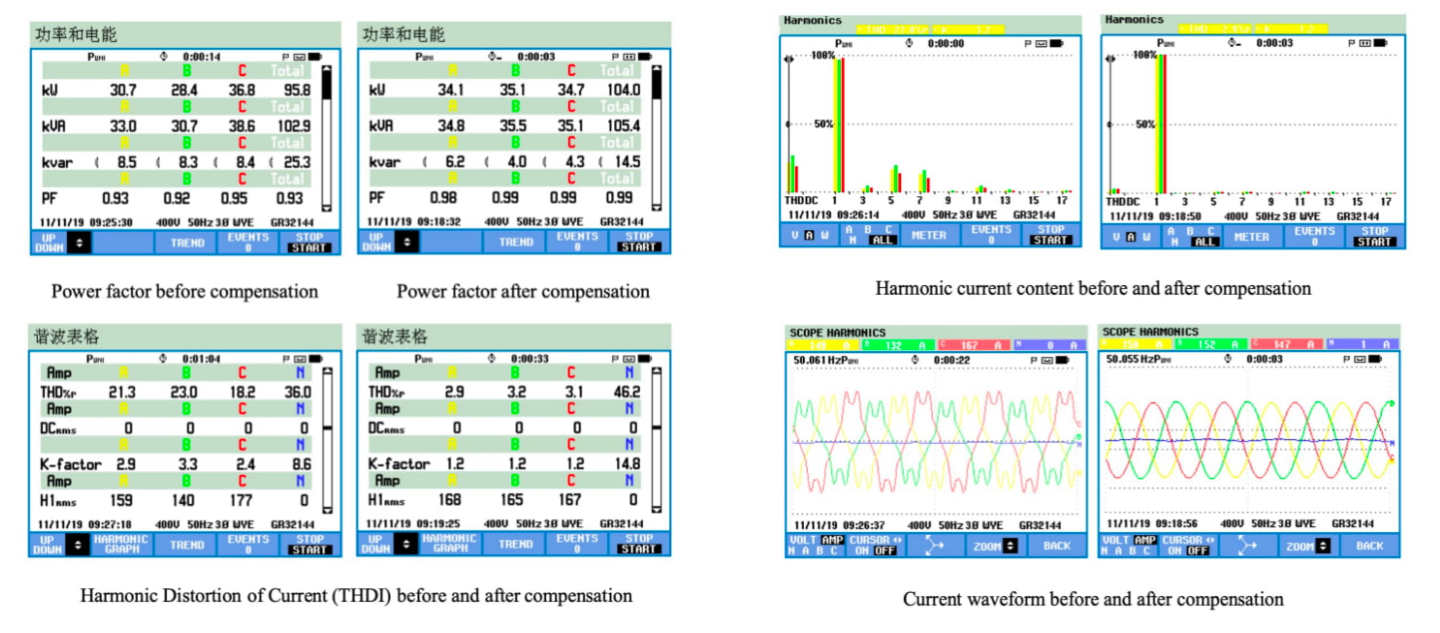
The APF equipment reportedly reduced THDi to below 3.2%. The SVG reportedly raised the power factor to above 0.98 and eliminated voltage distortion and flicker.
Energy Saving and Lower Operating Cost
It reports a 14.5% reduction in line losses, a 90% reduction in reactive power losses, RMB 1.7 million in annual electricity-cost savings, and an 8.5-month payback period.
Compliance and Future Expansion
The reserved capacity is intended to support the planned 5,000-rack expansion without major additional investment in distribution-system reconstruction.
Improved O&M Efficiency
Integration with the existing intelligent O&M platform enables remote monitoring, fault alerts, and parameter adjustment for APF and SVG equipment.
Power Quality Issues and Their Impact
Harmonic Pollution and Equipment Reliability
UPS systems, switching power supplies, and liquid-cooling circulation systems generated excessive harmonics. Guizhou Data Center reports a harmonic distortion index of up to 24%, causing instantaneous outages in server clusters and false alarms in precision monitoring equipment.
Reactive Power Loss and Higher Operating Cost
The data center experiences large load fluctuations. AI server cluster start-up and liquid-cooling system activation produce reactive power surges. Guizhou Data Center reports that the power factor fell as low as 0.81 and the line-loss rate reached 11.5%.
Shorter Equipment Life and Higher O&M Cost
Harmonic current continuously affected transformers, distribution cabinets, server power modules, and liquid-cooling systems, accelerating insulation aging. Guizhou Data Center reports a 30% reduction in mean time between failures and a 22% increase in equipment failure rate.
Power Quality Issue
Source-Reported Condition
Reported Operational Impact
Harmonic distortion
THDi up to 24%
Server-cluster interruptions and precision-monitoring false alarms
Reactive power
Power factor as low as 0.81
Higher line loss and more than RMB 1.7 million in annual electricity cost
Line loss
11.5% loss rate
Increased equipment heat and cooling-system burden
Reliability
30% reduction in MTBF; 22% increase in failure rate
Nearly RMB 1 million increase in annual O&M cost
Conventional compensation
Slow response
Unable to meet the dynamic-load requirement
APF + SVG Collaborative Solution
Based on an on-site survey, load-data analysis, and a comparison of multiple solutions, the project selected a collaborative solution combining an Active Power Filter (APF) and a Static Var Generator (SVG).
Core Equipment Selection
The project replaced the existing capacitor-based reactive power compensation system with APF and SVG equipment. The new equipment was selected to meet requirements for limited space, high reliability, green energy efficiency, and compatibility with liquid-cooling operation.
Active Power Filter (APF)
The project deployed ten modular APF units with a total compensation capacity of 4,000 A. Guizhou Data Center reports filtering efficiency of 99%, response time below 5 ms, and mitigation of the 2nd through the 51st harmonic orders.
Static Var Generator (SVG)
The project deployed ten modular SVG units with a total compensation capacity of 3,000 kvar. Guizhou Data Center reports response time below 5 ms, continuous dynamic reactive power compensation, and a maintained power factor above 0.99.
Deployment Plan
The deployment plan combines centralized management with zoned compensation based on the data center’s power distribution architecture, building layout, and load characteristics.
Main low-voltage distribution inlet: APF and SVG units were centrally deployed to address harmonic pollution and reactive power loss across the data center.
Liquid-cooled and intelligent computing areas: Small APF modules were deployed in zones with UPS clusters, liquid-cooling systems, and high-frequency switching power supplies.
Intelligent O&M integration: All devices were connected to the data center’s intelligent O&M platform for coordinated control, real-time monitoring, fault alerts, and remote maintenance.
Advantages of the APF + SVG Architecture
Intelligent Control
The system tracks dynamic loads and automatically adjusts compensation parameters to avoid overcompensation and undercompensation.
Reliability and Resilience
The APF uses a parallel multi-module architecture. The SVG includes overvoltage, overcurrent, and overtemperature protection. Guizhou Data Center reports MTBF of up to 80,000 hours and a design service life of 10 years.
Scalability
The modular design supports online capacity expansion and reserves 20% compensation capacity for a future 5,000-rack expansion.
FAQ: APF and SVG in This Project
What power quality issues did the project address?
The project addressed harmonic pollution, reactive power loss, line loss, equipment overheating, shorter equipment life, and increased O&M cost.
What equipment was deployed?
Ten modular APF units totaling 4,000 A and ten modular SVG units totaling 3,000 kvar.
Where was the equipment installed?
APF and SVG units were centrally installed at the main low-voltage distribution inlet, with small APF modules installed in liquid-cooled and intelligent computing rooms.
What results were reported after implementation?
THDi below 3.2%, power factor above 0.98, 14.5% reduction in line losses, 90% reduction in reactive power losses, RMB 1.7 million annual electricity-cost savings, and zero reported power-quality outages.
How does the design support expansion?
The modular design reserves 20% compensation capacity for a future 5,000-rack expansion.