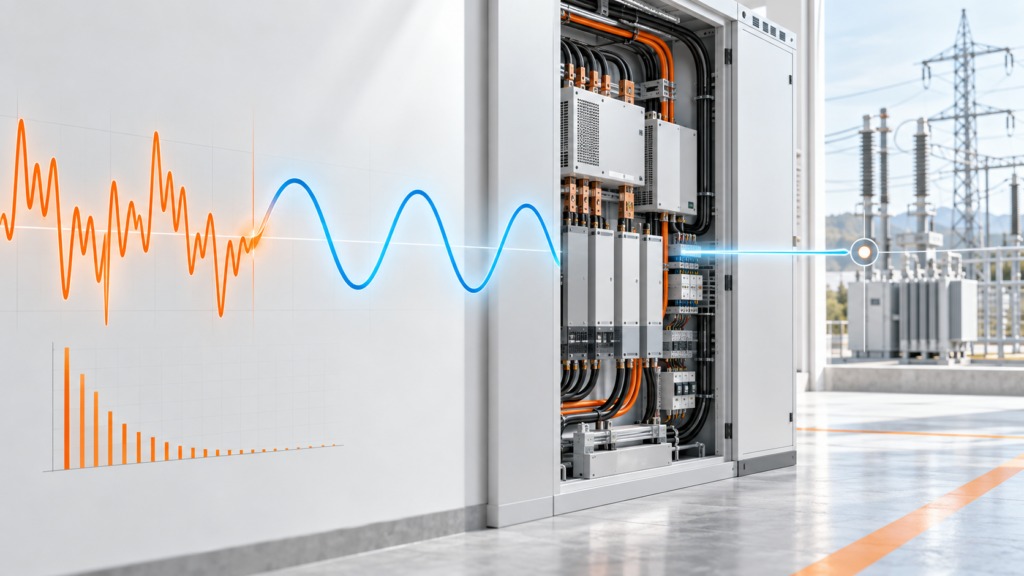
When a power quality report shows 5%, 8% or a higher THDi value, the first reaction is often to ask whether the result is acceptable. The useful answer depends on where the measurement was taken, how heavily the system was loaded and which limit is being applied. A single percentage without this context can lead to an oversized filter, an ineffective correction plan or an unnecessary investment.
THDi describes harmonic current as a percentage of the measured fundamental current. It is a valuable diagnostic value, but it changes with load. At light load, the fundamental current falls and the measured THDi can rise even when the actual harmonic current has not increased. For system compliance, engineers commonly evaluate harmonic current at the point of common coupling and relate the permitted current distortion to the ratio of available short-circuit current to maximum demand load current.
| Question | Useful measurement | Why it matters |
|---|---|---|
| Is the supply voltage being distorted? | THDv and individual voltage harmonics at the PCC | Shows the effect on the shared electrical system |
| How nonlinear is a load? | THDi and individual current harmonics at the load | Helps identify the source and size mitigation |
| Is the result compliant? | TDD, maximum demand current and short-circuit ratio | Connects the measurement to the applicable system limit |
| What equipment is needed? | Harmonic spectrum, RMS current, power factor and load profile | Separates AHF, SVG and capacitor-bank requirements |
Five percent is widely used as a practical discussion point for voltage distortion or a desired residual current-distortion target. Eight percent may appear in equipment specifications, internal plant criteria or measurements taken under a particular load condition. Neither number should be accepted without checking the metric, voltage class, measurement point and operating state. IEEE 519 system objectives are applied at the PCC; they are not a universal nameplate certification for an active harmonic filter.
For a clear comparison of the two headline measurements, see THDi vs THDv: What Is the Difference in Power Quality?. For project-level compliance planning, review the IEEE 519 and IEC 61000 compliance guide.
A reliable survey records minimum load, normal production and peak production. It should identify transformer data, generator operation, large VFDs, UPS systems, rectifiers, welders and renewable-energy inverters. Capture individual harmonic orders as well as total distortion. A high fifth harmonic suggests a different current profile from a system dominated by the third harmonic and neutral current.
An active harmonic filter injects compensating current for selected harmonic orders and can adapt when the load changes. A static var generator responds quickly to reactive-power demand and phase imbalance, but it is not a substitute for an AHF when harmonic current is the main problem. Capacitor banks provide economical steady-state reactive power, yet they require a resonance review when background harmonics are present. Mixed sites often benefit from a coordinated AHF, SVG and detuned-capacitor design.
No. The applicable objective depends on the project specification, measurement point and system strength. A residual target below 5% may be desirable, but the decision should use the full measurement set.
Yes. At light load the fundamental current can be small, which increases the percentage. Record RMS harmonic amperes and load current together with THDi.
Not automatically. Reactive-power correction and harmonic-current mitigation solve different electrical problems, although one coordinated system can address both.
If you share the single-line diagram, transformer data, maximum demand current and harmonic spectrum, Elumotive can review the measurement context and prepare an initial AHF, SVG or hybrid recommendation. Contact our engineering team to discuss the project.