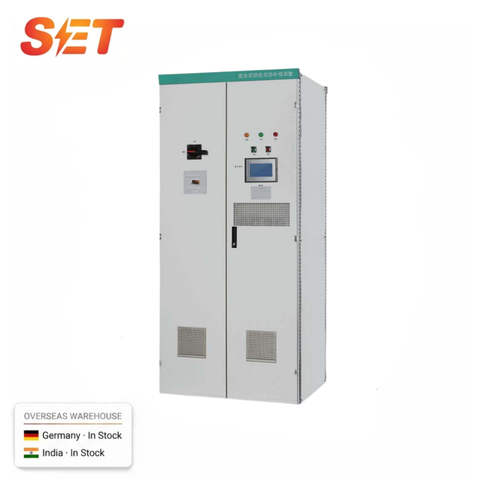
Model: SET-HYBRID-PFC-400
SET Hybrid Power Factor Correction System combines SVG and switched capacitor stages for 400 V industrial loads from 50 to 900 kvar, with ≤5 ms SVG response, harmonic control and three-phase load balancing.
SET Hybrid Power Factor Correction System combines fast SVG compensation with economical switched capacitor banks in one coordinated cabinet. It is designed for industrial loads that include both steady reactive demand and rapidly changing load conditions.
The system provides dynamic reactive-power compensation, harmonic control and three-phase load-imbalance mitigation while keeping the bulk compensation stage economical. Final capacity, switching scheme and installation format are confirmed during project engineering.
| Parameter | Specification |
|---|---|
| Product type | Hybrid SVG + switched capacitor power-factor correction system |
| Rated voltage | 400 V (operating range 296–465 V) |
| Rated capacity | 50–900 kvar |
| Main frequency | 50/60 Hz ±5% |
| Circuit topology | Three-level |
| Compensation modes | Harmonic control, reactive-power compensation and three-phase load-imbalance compensation |
| Filtering range | 2nd–51st odd harmonics, selective or full compensation |
| Harmonic reduction rate | ≥97% |
| Filtering performance | Typically THDi ≤5% at rated loads |
| Target power factor | System PF >0.98 after compensation at rated capacity |
| Three-phase load balancing | ≤5% negative- and zero-sequence current mitigation |
| Neutral-line filtering | Up to 3 times the rated filtered current for four-wire devices |
| SVG switching/control frequency | 25.6 kHz |
| SVG response time | ≤5 ms |
| Capacitor control interface | 16 ways |
| Capacitor switching | Thyristor or contactor |
| Capacitor response time | ≤1 s |
| Output current limit | Automatically limited to 100% of rated output |
| Control algorithm | FFT, adaptive control and reactive-power algorithms |
| Controller | DSP + FPGA |
| Protection | Hardware and software protection |
| HMI | 4.3-inch, 7-inch or 10-inch touch TFT LCD |
| Noise | <60 dB; <45 dB at low-speed operation |
| Installation | Embedded/rack, wall-mounted or floor-mounted |
| Protection level | Up to IP43 |
| Cooling | Speed-controlled intelligent air cooling with PWM fan |
| Cabinet colour | RAL 7035 industrial grey |
| Ambient temperature | −20 to +55 °C |
| Relative humidity | ≤95%, non-condensing |
| Installation altitude | Rated capacity up to 2,000 m; derating above 2,000 m |
| Compliance | IEEE 519, IEC 61000, CE, type-test report and ISO 9001:2015 |
| Communication | Modbus RTU, TCP/IP, dual RS485, CAN bus, mobile APP and Ethernet |
The capacitor stage supplies economical stepped compensation for the stable part of the load. The SVG module continuously corrects fast reactive changes and can support harmonic and imbalance control. The controller coordinates both stages so that the capacitor bank is not forced to follow every rapid fluctuation.
The SET hybrid power factor correction system is designed for facilities where steady reactive demand and fast load changes occur together. The capacitor stages cover the base kvar economically, while the SVG module responds to rapid changes, helping maintain power factor and stable power quality.


Final SVG rating, capacitor-step configuration, filtering range and enclosure format should be selected from the site load profile and power-quality measurements.
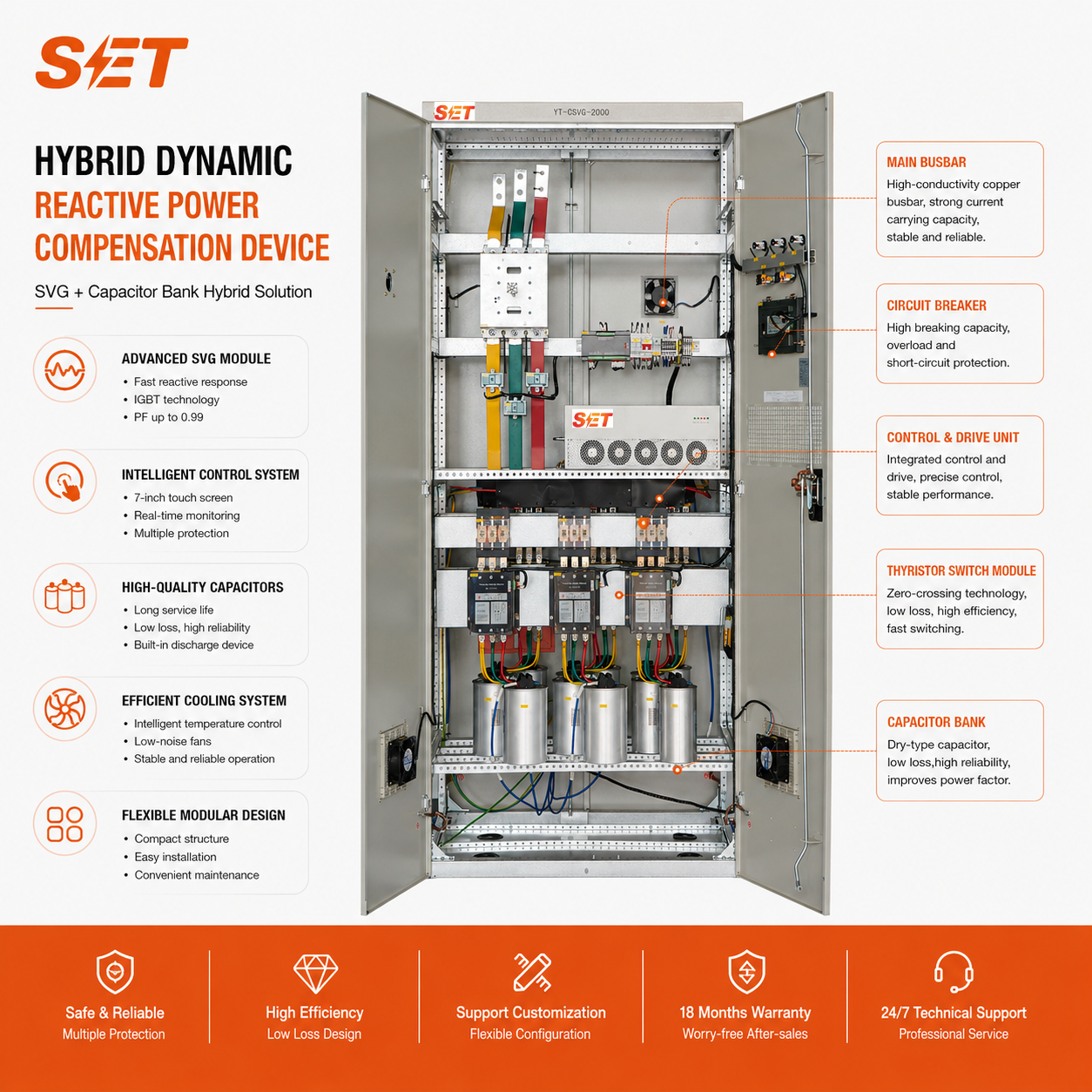
A hybrid system is suitable when most of the reactive demand is steady but a smaller portion changes quickly. The capacitor stage handles the bulk demand economically while the SVG covers dynamic fluctuations.
This page describes the 400 V version with a 296–465 V operating range. Other voltage and cabinet configurations can be reviewed during project engineering.
Harmonic-control functions are configured according to the project requirement. Final filtering range, capacity and measurement points should be confirmed from a site power-quality survey.
Send us your system voltage, load capacity, target power factor, harmonic measurements and preferred installation method. SET engineers will confirm the configuration and provide a technical proposal.