Power quality for welding machines is a production issue as well as an electrical issue. Resistance welders, robotic cells and servo drives create rapid current changes, voltage dips, harmonics and phase imbalance. A coordinated AHF, SVG or hybrid VAR system can stabilize the line while protecting transformers, controls and sensitive automation.
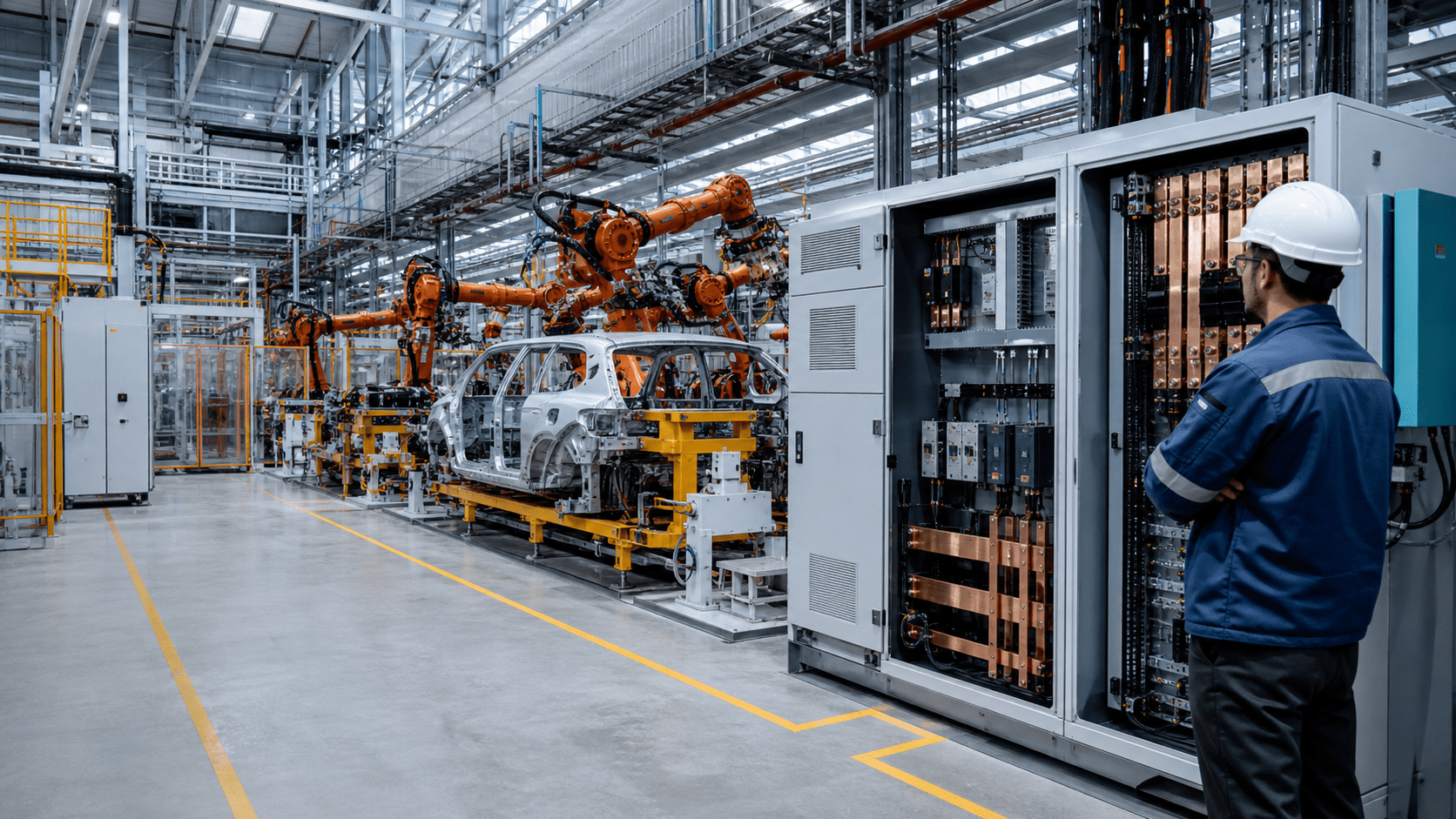
Start with synchronized voltage and current measurements at the welding transformer, robot cell and plant incomer. Capture the weld pulse, robot acceleration, idle period and simultaneous operation of multiple cells. Look for voltage flicker, negative-sequence current, low power factor and harmonic peaks from rectifiers or servo drives. The timing of the event is as important as its magnitude.
An SVG can supply fast reactive current and improve three-phase balance during weld pulses. An AHF addresses harmonic current from rectifiers, drives and power electronics. If the line has a steady base kVAR as well as fast pulses, a hybrid VAR cabinet can combine capacitors with SVG response. Locate CTs so the controller sees the welding load without compensating unrelated feeders.
A switched bank may cover steady reactive demand, but it is usually too slow for weld pulses and can increase resonance risk.
Place CTs where the system must observe and correct the welding or robot-cell current. The exact point depends on the feeder arrangement.
Check voltage dip, flicker, THDi, phase balance, power factor and production alarms before and after installation.
Use the results to compare active harmonic filter solutions, SVG and hybrid VAR systems and power capacitor systems. The equipment rating should follow the measured load profile, available fault level, cabinet environment and planned expansion.
Send a welding-cycle waveform and single-line diagram to Elumotive for a power-quality solution review. For reference, review this power-quality resource and compare the measured result with your site requirements.
Keep the one-line diagram, test records, protection settings and commissioning results together with the quotation. A documented baseline lets the maintenance team verify improvement after installation and gives procurement a clear specification for future expansion.
Review the measurements again after major process changes, transformer replacement, generator operation or renewable-energy expansion. This simple follow-up keeps the power quality for welding machines recommendation aligned with the real operating conditions.
Use measured operating data to choose the control mode, current rating and protection settings. The same equipment can behave differently at light load, normal production, generator operation or renewable-energy export, so the final specification should describe each scenario. Keep the baseline waveform, harmonic spectrum and power-factor trend with the project file.
After installation, repeat the measurements and compare the result with the agreed acceptance values. Check temperature, alarms, communication, phase balance and response during the most demanding process step. This follow-up turns a one-time purchase into a repeatable power-quality improvement plan and gives the maintenance team a clear reference for future expansion.


Leave a Comment