Hybrid VAR compensation sizing combines the fast response of an SVG with the economical bulk capacity of switched capacitors. The design is useful when a plant has a steady reactive base load plus rapid changes from cranes, welders, compressors, furnaces or renewable-energy converters. Correct sizing keeps the power factor stable without overusing the electronic converter.
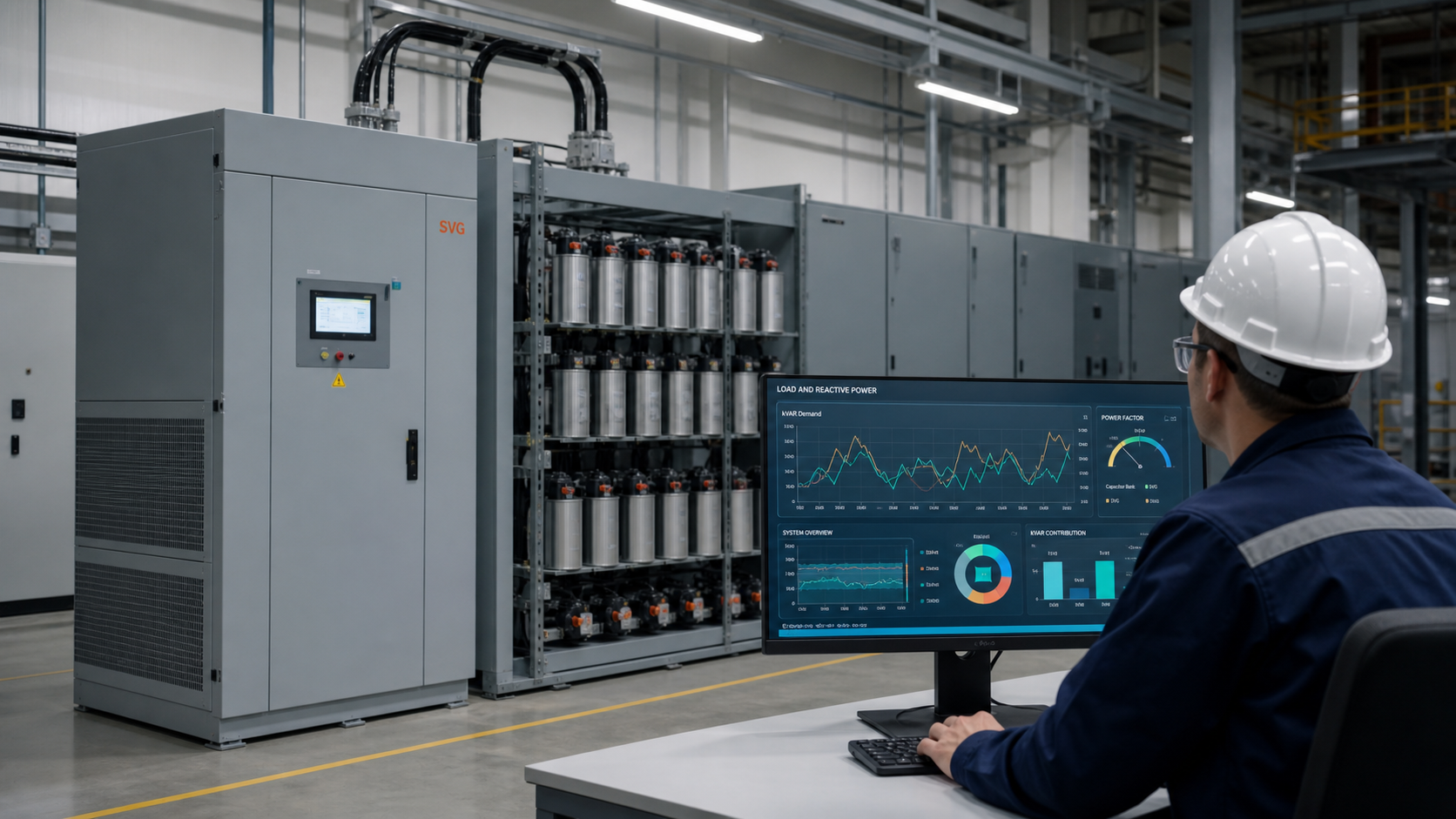
Start with a load profile that shows minimum, average and peak reactive demand. The capacitor bank can cover the predictable base kVAR while the SVG handles the difference that changes quickly. Review the power factor target, switching steps, minimum load and the response time required by the process. A hybrid design should not switch capacitors into a highly distorted bus without checking resonance and detuning requirements.
The controller should give priority to the SVG for fast correction and use capacitor stages for slower bulk compensation. Set a dead band to avoid unnecessary switching, and confirm discharge time, contactor or thyristor ratings and capacitor temperature limits. If the plant also has nonlinear loads, add harmonic measurements and consider an AHF or hybrid SVG configuration so the capacitor bank is not exposed to damaging resonance.
The capacitor bank supplies economical base kVAR while the SVG responds to rapid changes and balances the phases.
The SVG corrects reactive current and imbalance. Harmonics normally require an AHF or a hybrid device with a dedicated filtering function.
It depends on the dynamic portion of the kVAR profile, not the full installed capacitor capacity. Use measured trends rather than transformer size alone.
Use the results to compare active harmonic filter solutions, SVG and hybrid VAR systems and power capacitor systems. The equipment rating should follow the measured load profile, available fault level, cabinet environment and planned expansion.
Send your kVAR trend and target power factor to Elumotive for hybrid VAR compensation sizing. For reference, review this power-quality resource and compare the measured result with your site requirements.
Keep the one-line diagram, test records, protection settings and commissioning results together with the quotation. A documented baseline lets the maintenance team verify improvement after installation and gives procurement a clear specification for future expansion.
Review the measurements again after major process changes, transformer replacement, generator operation or renewable-energy expansion. This simple follow-up keeps the hybrid VAR compensation sizing recommendation aligned with the real operating conditions.
Before approving the equipment schedule, ask which feeder is being measured, what operating state created the highest demand and how the result will be verified after commissioning. Confirm the transformer impedance, generator mode, cable length, ambient temperature and available cabinet space. These details influence the control strategy as much as the nominal kVA value.
Document the expected improvement in measurable terms: residual THDi, target power factor, phase-current balance, response time and alarm limits. A clear acceptance test should include light load, normal production and the most demanding process step. If the plant will add drives, UPS units, welders, solar inverters or battery storage, reserve capacity for that change.
Keep the final test report with the single-line diagram and maintenance instructions. This gives the next engineer a reliable reference instead of forcing the team to repeat the entire investigation. It also makes supplier quotations easier to compare because every bidder receives the same technical baseline.


Leave a Comment