Model: SET-UPQC-60/T to SET-UPQC-200/T
SET-UPQC 380V unified power quality conditioner for 60-200 kVA systems. Fast ≤1 ms voltage regulation, <100 μs electronic bypass, ≥98% efficiency and IP54 protection for weak grids, industrial feeders and renewable-energy connections.
The SET 380V UPQC is a fast, series-connected voltage-quality solution for distribution networks affected by persistent overvoltage, undervoltage, voltage fluctuation, sag, swell and supply-voltage unbalance. It regulates the load-side supply in real time, helping utilities and industrial users maintain stable voltage without large-scale feeder reconstruction.
Long rural feeders, terminal grids, industrial parks and renewable-energy connections can experience large and rapid voltage changes. Transformer expansion, new cable installation or feeder reconstruction may require significant time and investment. SET-UPQC uses modular power-electronic regulation and series compensation to provide a deployable alternative for targeted voltage-quality improvement.
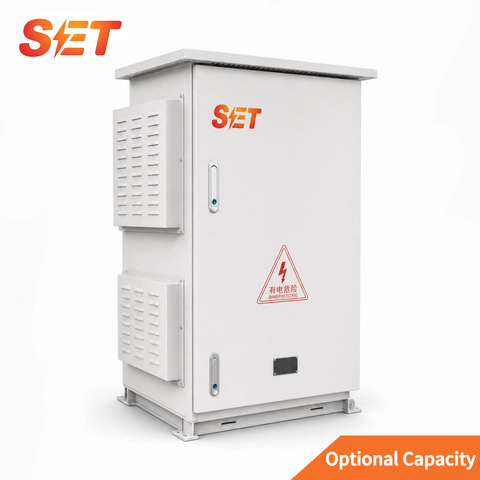
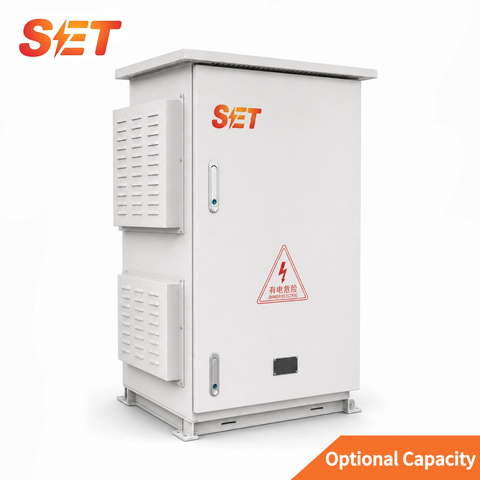
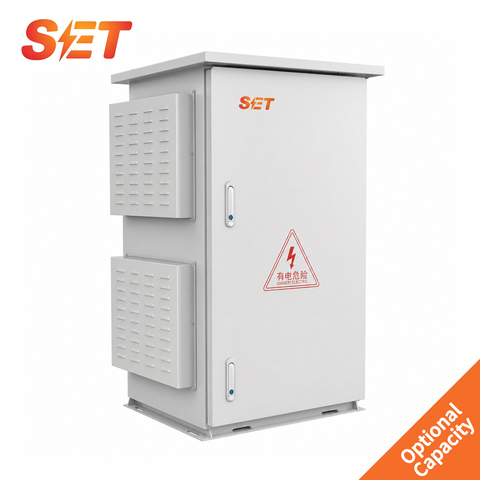
The SET 380V UPQC combines power conversion, transformer compensation, system monitoring and bus switching in one coordinated platform. The power-routing and transformer-compensation modules work together to adjust the load-side voltage continuously, while the monitoring and bypass functions support safe operation and maintenance.
| Model | Rated capacity | Rated output current | Cabinet dimensions (W × D × H) |
|---|---|---|---|
| SET-UPQC-60/T | 60 kVA | 90 A | 900 × 690 × 1100 mm |
| SET-UPQC-100/T | 100 kVA | 150 A | 900 × 750 × 1200 mm |
| SET-UPQC-150/T | 150 kVA | 225 A | 1000 × 950 × 1300 mm |
| SET-UPQC-200/T | 200 kVA | 300 A | 1000 × 950 × 1300 mm |
Project documentation also describes single-phase solutions in the 35-50 kVA range and modular 25/50 kVA construction. Please confirm the feeder topology and required correction range with SET engineering before selection.
| Parameter | Specified value |
|---|---|
| Nominal system voltage | 380 Vac, three-phase five-wire (3L + N + PE) |
| Input-voltage operating range | 380 Vac (-25% to +25%) |
| Operating frequency | 50 Hz (-5% to +5%) |
| Regulated voltage range | 380 Vac (-15% to +15%) |
| Regulation accuracy | ±1% (product data sheet) |
| Voltage distortion | ≤ 3% |
| Dynamic response time | ≤ 1 ms |
| Electronic bypass time | < 100 μs |
| Grid-side power factor | ≥ 0.99 |
| Grid-side current distortion | ≤ 3% |
| Efficiency | ≥ 98% |
| Overload capability | 1.5 times rated capacity for 10 minutes |
| Protection functions | Overvoltage, undervoltage/loss of voltage, overcurrent and overtemperature |
| Ingress protection | IP54 |
| Ambient temperature | -20 °C to +55 °C |
| Relative humidity | ≤ 93% at 25 °C, non-condensing |
| Installation altitude | ≤ 2000 m at rated output; derating required above 2000 m |
Improves voltage at remote load points where long supply radius, small conductor size or seasonal demand causes repeated undervoltage.
Stabilizes supply to concentrated production loads when upstream voltage varies or feeder impedance is high.
Helps manage high-voltage conditions caused by reverse power flow and rapid changes in local PV generation.
Supports load-side voltage quality in networks affected by variable generation and changing operating conditions.
Installation, wiring, bypass operation and commissioning must be performed by qualified electrical personnel. Capacity and cable selection should be verified against the actual load current, voltage deviation and site conditions.
This product family is specified for 380 Vac low-voltage distribution systems. Contact SET for projects with other nominal voltages.
The specified dynamic response is no more than 1 ms, with electronic bypass transfer below 100 μs.
Selection depends on load current and the required correction range. The three-phase series covers 60, 100, 150 and 200 kVA.
Yes. The system includes a monitoring terminal for grid, load, module and event data; interface details are confirmed during project engineering.
SET engineers can review your voltage records, feeder configuration and load data, then recommend the appropriate capacity, cabinet arrangement and installation point.